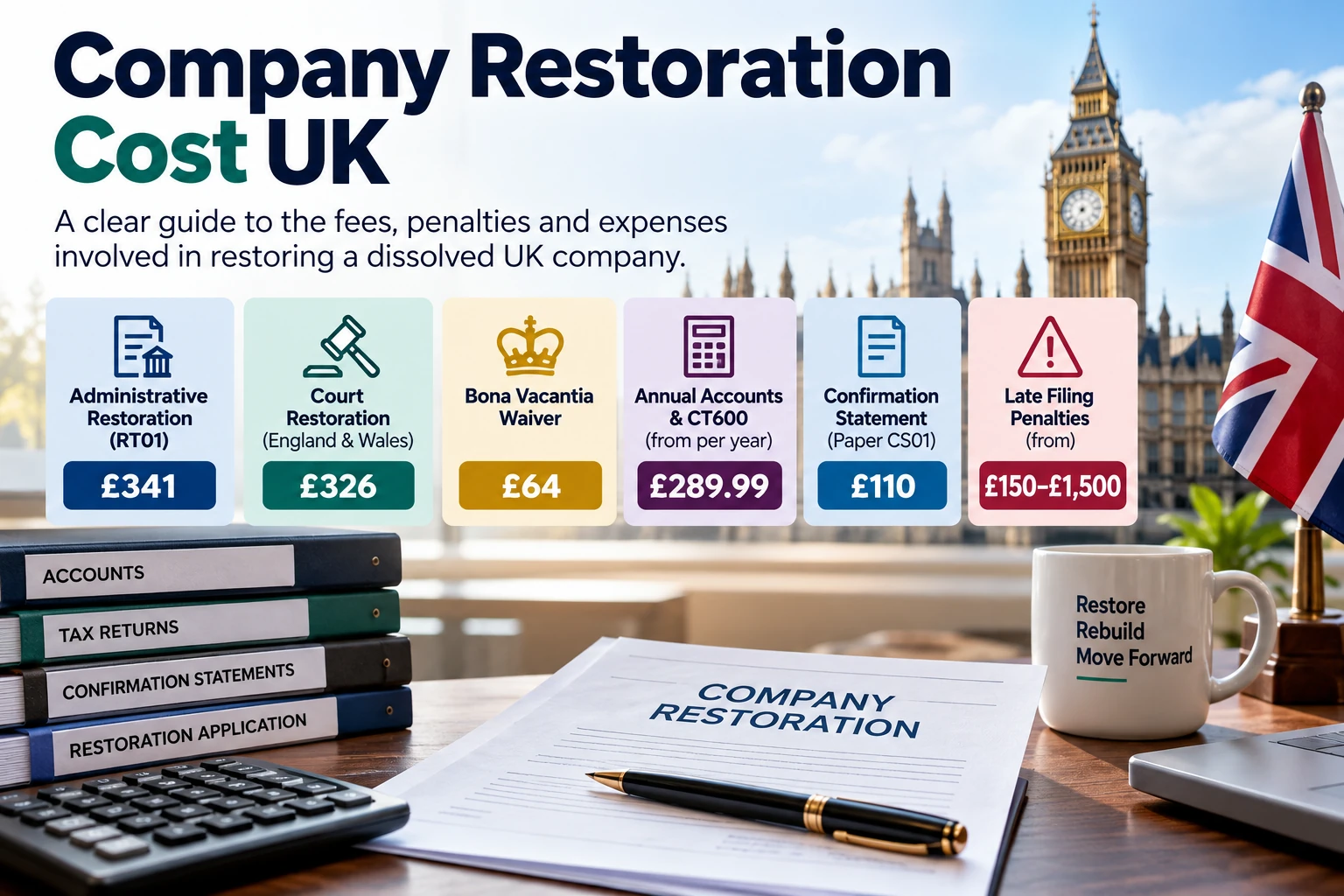
The company restoration cost UK applicants pay depends on the restoration method, statutory fees, and outstanding company obligations. Administrative restoration carries a £341 Companies House fee, while court restoration costs £326 in England and Wales. Additional expenses may include professional fees, overdue accounts, confirmation statements, bona vacantia charges, and late filing penalties. Understanding these costs helps directors and shareholders plan their budgets and avoid unexpected expenses.
The company restoration cost UK applicants pay starts at £341 for administrative restoration, excluding other expenses. Court restoration starts with a £326 court application fee in England and Wales. Both routes can involve additional accounting, legal, and statutory charges.
The £341 RT01 fee and £326 court application fee relate to different procedures. Applicants do not normally pay both.
These examples use hypothetical service requirements. They exclude additional penalties, taxes, and unlisted legal expenses.
The Companies House restoration fee is £341 for an administrative restoration application using Form RT01. Companies House charges this amount when qualifying applicants request restoration through the administrative procedure. Former directors or shareholders can normally apply within six years of dissolution, subject to statutory conditions. The company must also satisfy the relevant activity and dissolution requirements.
The RT01 fee covers the statutory application to Companies House.
It does not include:
Outstanding annual accounts
Confirmation statement filing charges
Existing late filing penalties
Bona Vacantia waiver costs
Professional application preparation
For example, a company with two overdue accounting periods may need additional financial statements. The accountant's preparation charges remain separate from the official application fee. Applicants comparing the company restoration cost with UK service providers' quotes should distinguish these expenses.
The court fee for company restoration is £326 for the relevant application in England and Wales. Applicants generally submit Form N208 with supporting evidence. Court restoration may apply after voluntary dissolution or when administrative restoration is unavailable. The court restoration cost UK applicants face can increase because of legal preparation and additional expenses.
For example, a creditor restoring a company to pursue unpaid debts may require specialist legal assistance. Court applications involving disputed assets can involve more work than straightforward cases. Scotland and Northern Ireland have separate court procedures and fee structures.
Professional fees for company restoration cover specialist preparation, compliance reviews, and application assistance. Accountants can identify outstanding documents and help prepare historical financial information. Solicitors can provide advice on legal proceedings, court documents, and disputed matters. Professional administrative restoration support may start from £349.99. This is an illustrative starting price rather than a government-set charge.
Depending on the provider, services may include:
Reviewing the company's dissolution history
Identifying outstanding statutory documents
Preparing the RT01 application
Coordinating Crown correspondence
Liaising with Companies House
Reviewing compliance requirements
A provider may charge separately for accounting services, confirmation statements, and legal work.
All professional fees in this guide are illustrative budgeting assumptions. They are not guaranteed quotations. An itemised quotation helps applicants compare services on the same basis.
Bona Vacantia costs during restoration can include a £64 waiver application fee and additional asset-related expenses. When a company dissolves, qualifying property and rights may pass to the Crown as bona vacantia. These can include bank balances, land, shares, and intellectual property. Administrative restoration involves obtaining the relevant Crown representative's consent under applicable rules. That consent is commonly called a Bona Vacantia waiver letter.
The Companies House RT01 application guidance lists a Bona Vacantia waiver letter among the supporting documents. Its general restoration guidance specifically addresses cases where property or rights passed to the Crown. The Government Legal Department explains that administrative restoration requires the applicable Crown representative's written consent. However, its Treasury Solicitor application process has particular conditions. Applicants should only use that process when the company meets the following requirements:
The company dissolved within the previous six years.
Companies House compulsorily struck the company off.
The company held assets within the Treasury Solicitor's jurisdiction in England or Wales.
The Treasury Solicitor charges £64 for qualifying waiver applications. Different Crown representatives deal with relevant assets in Scotland, Northern Ireland, and certain other jurisdictions.
Consider a dissolved company with £12,000 remaining in its business bank account. The former director wants to restore the company and recover the money. The applicant must establish which Crown representative handles the relevant assets.A Treasury Solicitor waiver may apply when the company meets its jurisdictional conditions. Additional costs can arise if the Crown representative has already dealt with company property.A company with no assets should confirm its specific consent and documentation requirements before applying. The Bona Vacantia waiver cost is separate from the Companies House restoration fee.
Late filing penalties during restoration depend on the filing deadlines and the company's history before dissolution. Companies House imposes automatic penalties when companies file annual accounts after the deadline.However, special rules apply when a dissolved company returns to the register. The Registrar normally disregards the dissolution period when calculating relevant late filing penalties.
Companies House doubles the relevant penalty when accounts arrive late in two successive financial years.Public limited companies have different penalty rates.
Consider a company whose accounts became overdue two months before dissolution. The director later submits those accounts during restoration. Companies House normally treats the accounts as two months late, excluding the dissolved period.This produces a £375 standard penalty, assuming the doubling rules do not apply.Now consider accounts whose filing deadline arose entirely during dissolution.The company does not incur late filing penalties solely because that deadline passed while it remained dissolved.
Previously issued penalties can still remain outstanding.These distinctions help applicants calculate restoration late filing penalties without overstating their liabilities.HMRC applies separate rules to corporation tax returns, interest, and tax penalties.
The cost of preparing overdue accounts depends on accounting periods, transaction volumes, and the condition of financial records. Restoration may require businesses to bring outstanding statutory accounts up to date. An accountant reviews bank transactions, balances, and supporting documents before preparing financial statements.For example, the Annual Accounts & CT600 service advertised on companyrestorationuk.com starts from £289.99. This is a professional service price, not a statutory filing charge.
These estimates multiply an assumed £289.99 starting rate. They are not fixed quotations for multi-year work.
For example, a business with 80 transactions and complete bank statements may require relatively straightforward preparation.Another company with missing records and substantial trading activity may need additional bookkeeping.Dormant companies may have simpler accounts, but dormant status does not automatically remove statutory filing obligations.The UK estimate for company restoration costs should reflect the actual work required for each accounting period.
Confirmation statement costs during restoration depend on the outstanding documents and their chargeable payment periods. A confirmation statement confirms essential information on the Companies House register. This includes relevant shareholder, share capital and company details. Companies House requires paper Form CS01 for confirmation statements submitted during restoration.
The £50 digital fee applies to eligible ordinary online submissions. For restoration filings, applicants should budget for the applicable paper CS01 charge. Companies House charges the annual fee with the first statement in each 12-month payment period. Additional statements during that same period do not normally generate another fee.
For example, two separately chargeable paper filing periods could result in £220. However, two outstanding statements do not automatically mean two separate fees. Applicants must confirm the relevant payment periods before calculating the amount.
The total cost of administrative restoration combines the application fee with necessary compliance and professional expenses.
The examples below use hypothetical cases and clearly stated pricing assumptions.
A former director seeks restoration of an eligible company.
Assume no accounts or confirmation statements remain outstanding, and a standard Treasury Solicitor waiver applies.
The £349.99 professional fee is an assumed starting price, not a guaranteed quotation.
A second company needs two accounting periods and one chargeable paper CS01.
This example assumes the £289.99 starting accounting price applies to both years.It excludes additional bookkeeping, penalties and other unlisted charges.The examples demonstrate how outstanding filings affect the overall restoration budget.
The total cost of court restoration includes court charges, solicitor services, and any relevant accounting or compliance work.The following examples use hypothetical solicitor fees solely for budgeting purposes.
Assume an England and Wales application with illustrative solicitor charges of £1,200.
The £1,200 solicitor fee is a hypothetical assumption, not a verified market quotation.
The example excludes registrar's costs, disbursements and historic liabilities.
Assume another company needs legal support and two accounting periods.
The solicitor charge is hypothetical. The accounting amount assumes both years qualify for the starting service rate.Actual court restoration expenses may differ substantially.
Overdue accounts, incomplete records, outstanding penalties, complex assets and court requirements increase company restoration costs.
Different obligations affect the final amount in different ways.
Each missing accounting period may require separate financial statements and tax work.
Missing invoices, bank statements and transaction records can increase bookkeeping expenses.
Companies House may require payment of penalties that arose before dissolution.
Property and financial assets can create Crown consent requirements and additional correspondence.
Complex legal applications can involve solicitor charges, registrar's costs and further court expenses.
Outstanding corporation tax, interest, and HMRC penalties remain separate from restoration application fees.
This classification helps applicants understand which charges apply to their specific restoration.
Applicants can reduce avoidable professional expenses by organising financial records and reviewing outstanding obligations early.Start with the company's filing history on the Companies House register.Identify missing accounts, confirmation statements and existing penalty notices.Gather bank statements, invoices and accounting documents for each outstanding period. Confirm whether administrative or court restoration applies before engaging specialist legal services.Finally, request a quotation that separates professional work from statutory charges.
Our Company Restoration UK: Complete Guide explains the wider restoration process.
The company restoration cost UK applicants face depends on statutory charges, outstanding compliance and professional requirements.Administrative restoration carries a £341 application fee. Court restoration involves a separate court application and possible legal expenses.Overdue accounts, confirmation statements, Crown consent and existing penalties can increase costs.
The minimum Companies House application fee for administrative restoration is £341 in 2026. However, this is not the total restoration cost. Additional expenses may include a £64 Bona Vacantia waiver, outstanding filings, late penalties and professional fees.
No, company restoration costs can vary across the UK. Companies House charges £341 for administrative restoration. However, court fees, legal expenses and Crown consent procedures may differ in England, Wales, Scotland and Northern Ireland.
Yes, you can restore a dissolved company without an accountant if you meet the eligibility requirements. You can complete Form RT01 and submit the required documents yourself. However, an accountant can help prepare outstanding accounts and resolve financial compliance issues.
No, late filing penalties are not always payable during company restoration. Companies House generally excludes the dissolution period when calculating penalties. However, penalties outstanding before dissolution may still apply. Accounts already overdue when the company dissolved can also attract penalties.
No, a Bona Vacantia waiver is not required in every restoration case. It generally applies when company property or rights passed to the Crown after dissolution. The requirements depend on the company's assets, restoration route and relevant Crown representative.
No, professional restoration fees do not always include government charges. Accountants and solicitors may charge separately for preparing applications and supporting documents. Companies House fees, Crown charges and court expenses may increase the total cost. Always request an itemised quotation.
Yes, outstanding HMRC debts can increase the overall cost of restoring a company. Unpaid Corporation Tax, interest and applicable tax penalties may remain outstanding. Restoring the company does not automatically remove these liabilities.
You can obtain an accurate company restoration quote by providing your company registration number and financial details. Include the dissolution date, outstanding accounts, confirmation statements and any unpaid penalties. An accountant can then assess the restoration route and estimate the relevant costs.

Specialists at Xact+ Accountants helping UK directors reinstate struck-off companies, meet Companies House and HMRC obligations, and recover frozen funds.
Speak to a restoration specialist today — most eligible companies are back on the register in 4–6 weeks.
Start restorationSend the basics. A case manager checks the register and comes back with the route, the documents and the official costs.
Start with how the company was dissolved.
These answers help estimate work and official costs.
We use these details only to prepare your email summary.
This is an indication from your answers, not a formal assessment.




Leave a comment