
You can recover money from a dissolved company bank account by restoring the company and arranging repayment through the bank or relevant Crown representative.When Companies House dissolves a limited company, its bank account becomes frozen. Remaining company-owned funds generally pass to the Crown under bona vacantia law.
However, the bank may still hold the balance when you begin recovery. Company restoration usually restores the business's legal rights. It does not automatically reopen its former bank account. The first step is to confirm where the money is held. You can then identify the appropriate restoration and repayment procedure.
To recover frozen company funds, establish the balance's location, restore the company where required, and submit the appropriate release documents.
The procedure depends on the organization holding the money.
Keep written evidence of the balance and any transfer. It will help the bank or Crown representative identify the money.
Banks freeze dissolved company accounts because the company has ceased to exist as a legal entity.Directors lose their former authority to operate the business account. Shareholders cannot withdraw the balance simply because they own the company's shares.
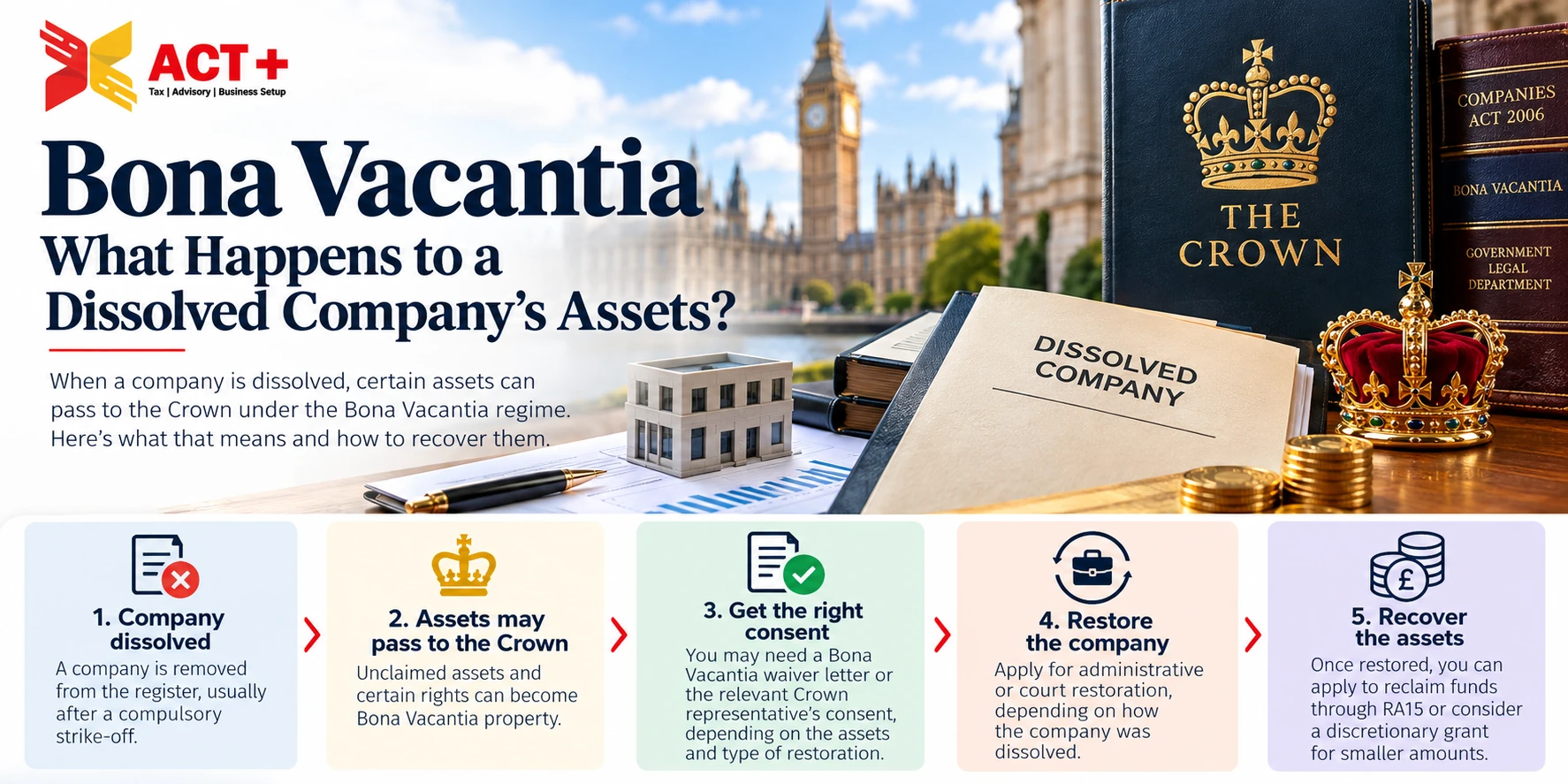
Section 1012 of the Companies Act 2006 provides that qualifying company property and rights pass to the Crown upon dissolution. The bank may suspend transactions, close the account and transfer the remaining balance to the relevant Crown representative.
Contact the previous bank's business account support or closure department.Provide the company's registration number, registered name and available banking information.
Ask for confirmation of:
The closing bank balance.
The date the account was restricted.
The date the account was closed.
Any amount transferred to the Crown.
The recipient authority and transfer date.
This information identifies the correct next step and supports later recovery applications.
Money belonging to a dissolved limited company generally becomes Crown property under section 1012 of the Companies Act 2006.Directors and shareholders do not automatically acquire personal ownership.
For example, a company may have £20,000 in its account when Companies House dissolves it. Its sole shareholder cannot treat that balance as personal savings. The company owned the money separately. Outstanding creditors, taxes and other liabilities may also affect how recovered funds can be used.
Company restoration generally treats the company as having continued in existence. Section 1028 of the Companies Act 2006 establishes this effect for administrative restoration. However, section 1034 addresses property disposed of by the Crown before restoration. The completed disposal remains effective. Instead, the restored company may become entitled to a statutory payment, subject to permitted deductions. The exact recovery entitlement depends on what happened to the asset during dissolution.
No. Former directors cannot normally withdraw money from a dissolved company's bank account. Access to an old banking application does not establish legal authority to transfer the funds.Restoration or another lawful recovery procedure must establish the relevant entitlement.
A director's payment may represent a loan, share capital, or another transaction. Consider a director who previously lent £8,000 to the company. The accounting records may show an outstanding director's loan. After restoration, the company can review its liabilities and determine whether repayment is appropriate. The director should retain loan records, payment evidence, and relevant company accounts.
Restoration is normally required when recovering money belonging to the dissolved company.The appropriate route depends on how the company was removed from the register.
Administrative restoration may be available when:
The Registrar struck off the company.
Dissolution occurred within the previous six years.
The company was trading when dissolved.
The applicant was a former director or shareholder.
The remaining statutory conditions are satisfied.
Applicants use Companies House form RT01.
Outstanding accounts, confirmation statements, relevant penalties and Crown consent documents may also be required.
Court restoration normally applies when directors voluntarily dissolved the company. It may also apply where administrative restoration is unavailable. The usual six-year application period has statutory exceptions. Court proceedings involve different documents, court requirements and costs.
Limited discretionary grant schemes provide alternatives for eligible applicants. The DG2 scheme concerns companies that can be restored. Qualifying applicants include former shareholders where all shareholders apply, and no existing creditors remain. Certain former insolvency officeholders may also qualify. Applicants must undertake not to restore the company later. The published maximum grant is £3,000.
The CB3 policy concerns companies that cannot be restored. Eligible applicants use form DG3. BVD normally considers former shareholders of solvent dissolved companies and certain former insolvency officeholders. Applicants must demonstrate hardship, compelling public interest, or circumstances making Crown retention unreasonable.Former directorship alone does not establish eligibility. Both schemes are discretionary.
The Companies House administrative restoration application costs £341.The published Bona Vacantia waiver-letter fee is £64 under the relevant procedure.Additional costs depend on outstanding filings, penalties and any professional assistance.
The RT01 and waiver charges total £405 where both apply.This excludes outstanding documents, statutory penalties and professional services.
DG2 and CB3 deductions reduce the amount paid through a discretionary grant. The charges depend on the applicable route.DG2 permits a maximum grant of £3,000. The Government Legal Department deducts a £300 administration fee. If the remaining balance exceeds £750, it also retains 5% of that balance.
For example, a qualifying £2,300 DG2 balance produces this calculation:
CB3 applies where the company cannot be restored. The Government Legal Department deducts proper legal costs and disbursements, usually £300. For grants over £750, it also retains 5% after deducting costs. The Treasury may require an additional deduction called the “Crown’s Share." Both routes are discretionary, so payment is not guaranteed
A limited company holds £18,000 when Companies House dissolves it.The bank subsequently transfers the money to the Government Legal Department's Bona Vacantia Division. Its former director confirms that the company qualifies for administrative restoration.The director prepares RT01, outstanding company documents and the applicable waiver letter. The RT01 and waiver charges total £405 before additional costs.After Companies House restores the company, the authorised applicant submits RA15.The application includes restoration evidence and the receiving bank statement.
Because the claim exceeds £10,000, the Government Legal Department requires the applicable anti-money laundering and identity checks.BVD reviews the documents before determining whether repayment can proceed. This example is illustrative. It is not an actual client case or a guaranteed recovery outcome.
Banks may request evidence of restoration, company ownership, and authority to operate the account.
The exact documents depend on the provider's requirements.
The provider may request additional information about the company's activities or previous transactions.Obtain its document checklist before applying for release.
Contact the previous bank once the restored company appears as active on the Companies House register. The bank may reopen the old account or require another arrangement for repaying the balance.
Download or retain the Companies House restoration confirmation.Keep any court order and updated company records.
Submit identification, ownership details and authority documents.The bank may require updated customer information before granting access.
Ask whether the previous account can be reactivated.Where reactivation is unavailable, request payment to another verified bank account belonging to the restored company.
Obtain the final statement or payment confirmation.Record the recovered amount in the company's accounting records.
You can apply through RA15 when the Government Legal Department's Bona Vacantia Division holds qualifying cash belonging to the restored company.BVD must have received the money before it can process repayment.
The published application requirements include:
A completed RA15 application.
A bank statement for the receiving account.
The Companies House restoration confirmation or court order.
A Payment Authority form for third-party repayment.
Certified identification where required.
Eligible applicants include company directors, secretaries, creditors, insolvency practitioners and liquidators.
For repayments below £10,000, identity documents are generally unnecessary when payment goes directly to the restored company.Third-party repayment requests require two certified documents: one proving identity and another proving residential address.
Where the company has multiple officers, each officer must sign the Payment Authority and supply the required certified identification.For repayments exceeding £10,000, anti-money laundering checks apply regardless of the receiving account.
Identity evidence is required for:
The RA15 signatory.
The majority of company officers.
Shareholders holding at least 25% of the company's shares.
The published guidance does not expressly clarify applications for exactly £10,000. Confirm the requirements with BVD before applying at that amount. A third-party payment does not automatically transfer beneficial ownership of the money to its recipient.
No. Different Crown representatives administer bona vacantia assets.The Government Legal Department handles qualifying cases within its jurisdiction in England and Wales.Scotland uses the King's and Lord Treasurer's Remembrancer. Northern Ireland has separate arrangements. The Duchies of Lancaster and Cornwall also handle relevant assets within their jurisdictions.
Old bank statements help reconstruct missing financial records before or during restoration.They can identify customer receipts, supplier payments, director loans, bank charges and tax transactions.A £12,000 closing balance does not establish £12,000 in taxable profit.The money may include loans, customer deposits or funds needed to settle creditors.Compare historical transactions with invoices and available accounting records. Review missing statutory accounts and confirmation statements before submitting restoration documents.
Banks have no single statutory deadline for releasing funds after company restoration.The provider's processing time depends on its account checks and repayment arrangements.For money held by BVD, the Government Legal Department publishes a processing period of up to 20 working days after receiving a complete and correct RA15 application.This excludes the period needed to restore the company.Missing documents, incorrect bank details and additional identity checks can delay repayment.Ask the bank for its processing estimate once all documents have been accepted.
Fintech providers may handle dissolved company balances differently from traditional banks. Some providers operate electronic money accounts rather than conventional deposit accounts.For example, a company using Wise may face restrictions following dissolution.Contact the provider to establish who holds the balance, whether it was transferred and which restoration documents are required.Do not assume that bank deposit rules apply identically to electronic money, safeguarded funds or marketplace payments.
Yes, recovery may still be possible without the old account number. Provide the company registration number, bank name, and any available historical statements to help identify the account.
No. Company restoration does not automatically unfreeze a bank account. The bank must review the company’s restored status and confirm its requirements for account access or repayment.
Yes. A bank may refuse to reopen a restored company’s old account. It may instead require a separate repayment procedure to return any funds it still holds.
Directors have no automatic right to receive recovered company funds personally. Any payment to a director requires proper authorisation and must account for the company’s debts and legal obligations.
The Bona Vacantia Division (BVD) allows up to 20 working days to process a complete and correct RA15 application. This period excludes the time needed to restore the company.
Recovery without restoration may be possible through a discretionary grant under DG2 or the CB3 policy. Each route has separate eligibility rules, deductions and application requirements. Payment is not guaranteed.
Repayment must go through the relevant Crown representative if the bank has transferred the funds. For qualifying cash held by BVD, restore the company before submitting an RA15 repayment application.
To recover money from a dissolved company bank account, obtain the closing balance and confirm who currently holds it. The company's dissolution history determines whether administrative or court restoration applies. After restoration, the bank or Crown representative reviews the repayment documents. Before applying, check outstanding filings, restoration costs and any company liabilities. Contact the previous bank first and request written confirmation of the account balance and any Crown transfer.

Specialists at Xact+ Accountants helping UK directors reinstate struck-off companies, meet Companies House and HMRC obligations, and recover frozen funds.
Speak to a restoration specialist today — most eligible companies are back on the register in 4–6 weeks.
Start restorationSend the basics. A case manager checks the register and comes back with the route, the documents and the official costs.
Start with how the company was dissolved.
These answers help estimate work and official costs.
We use these details only to prepare your email summary.
This is an indication from your answers, not a formal assessment.



Leave a comment