Court restoration is the legal process of returning a dissolved company to the Companies House register through a court order. It applies when administrative restoration is unavailable or an eligible person needs court approval. Court restoration UK applications can involve former directors, shareholders, creditors, and other interested parties. The correct procedure depends on the company's dissolution history and registered jurisdiction. Sections 1029 to 1034 of the Companies Act 2006 govern restoration by court order. These provisions explain who can apply, the time limits, and the court's powers. A company voluntarily struck off under section 1003 normally requires court restoration. Creditors can also use this route to pursue claims against dissolved companies. For England and Wales, applications normally use form N208 and a supporting witness statement. Scotland and Northern Ireland follow different procedures. The normal application deadline is 6 years from dissolution, although statutory exceptions exist.
Court restoration is required when a dissolved company cannot use administrative restoration or the applicant must follow the court route.A company voluntarily struck off under section 1003 requires a court order for restoration. Standard administrative restoration is unavailable after a directors' voluntary strike-off application.Court restoration also applies where creditors need to pursue outstanding debts. Other claimants may require restoration before continuing legal proceedings.An interested person may also need restoration to resolve contractual or property rights.
The court route covers companies struck off under several provisions:
Section 1000: Registrar's power to strike off a defunct company.
Section 1001: Registrar's power to strike off a company under specified circumstances.
Section 1002A: Registrar's power to strike off a company registered on a false basis.
Section 1003: Voluntary striking-off applications.
Regulation 22: Certain registered-office rectification cases under the 2024 Regulations.
Court restoration can also apply following specified winding-up or administration proceedings.
Section 1031 identifies the circumstances in which the court can order company restoration. For a company removed under section 1000 or 1001, the court considers its trading position. One statutory ground requires the company to have been operating when struck off.Section 1002A has a separate condition. The court considers whether the Registrar had reasonable cause for the relevant belief. For voluntary strike-off cases, the court considers compliance with sections 1004 to 1009. These provisions appear in sections 1029 to 1034 of the Companies Act 2006. The company's dissolution route and supporting evidence therefore determine the application.
Section 1029 allows former company officers, creditors and other legally interested parties to apply for restoration.
The statutory applicant categories include:
Former directors.
Former members or shareholders.
Creditors at the time of strike-off or dissolution.
Former liquidators.
People with potential legal claims.
People with qualifying contractual relationships.
People with specified interests in company land or property.
Managers or trustees of former employees' pension funds.
The Secretary of State.
Other persons appearing to the court to have an interest in the matter.
Certain persons entitled to notice of voluntary striking-off applications can also qualify.The applicant must establish their standing to apply under the relevant statutory provision.
A creditor can seek court restoration where a company owed money when it was struck off or dissolved.Section 1029 expressly includes eligible creditors.Restoration may allow a creditor to continue proceedings against the company. However, a restoration order does not automatically establish or recover the debt.The creditor may still need a judgment or enforcement proceedings.For example, a supplier may have an unpaid invoice against a dissolved company. Restoration can return the company to legal existence for the relevant claim.Evidence may include invoices, contracts, correspondence and details of the outstanding amount.The court considers the applicant's legal interest and the restoration grounds.
Former directors and former members can apply for court restoration where the statutory requirements are satisfied. A former director should first confirm the company's dissolution route.A company struck off voluntarily under section 1003 requires court restoration. Some registrar strike-offs qualify for administrative restoration instead. A shareholder may also seek restoration to deal with company property or outstanding affairs. The supporting evidence identifies the applicant's relationship with the company. Membership records, shareholding details, and company documents may be relevant. The applicant must also explain the reason for restoration.
A voluntarily dissolved company is restored through a court application under the Companies Act 2006.This normally applies where the directors requested voluntary strike-off under section 1003.The process begins with reviewing the company's history on the Companies House register.The applicant confirms the dissolution date and their legal standing.For England and Wales, the application normally uses form N208. A witness statement explains the circumstances and reasons for restoration.The applicant then files the claim with the appropriate court.
Companies House and the relevant Crown representative must receive the required documents.The court reviews the application and decides whether restoration is justified.If approved, the court issues a restoration order. The required order must then be delivered to Companies House.Restoration takes effect when that order reaches the Registrar.A voluntarily dissolved company cannot simply submit form RT01 instead.
The normal deadline for court restoration is 6 years from the company's date of dissolution.Section 1030 establishes the usual six-year limit.The period begins on the actual dissolution date. It does not begin when Companies House issues the first Gazette notice.For example, consider a company dissolved on 15 June 2022.Its normal six-year application period ends on 15 June 2028.The dissolution date should therefore be checked before proceedings begin.
Court restoration after 6 years is permitted only under specific statutory exceptions.Section 1030 allows certain personal injury-related applications without the standard six-year restriction.However, limitation rules affecting the underlying proceedings still apply.A separate exception concerns refused administrative restoration applications.This exception can apply where:
The company was struck off under section 1000, 1001 or 1002A.
An administrative restoration application was made within time.
The Registrar refused that application.
The court application is made within 28 days of the refusal notice.
The exception does not extend the deadline for every dissolved company.
The correct court depends on whether the company was registered in England and Wales, Scotland or Northern Ireland.Each jurisdiction has its own procedural requirements.
Court restoration in England and Wales normally begins with a Part 8 claim using form N208.Companies House states that restoration proceedings can be heard by:
The Companies Court in London.
District registries with the relevant jurisdiction.
County courts with authority to wind up the company.
The court's jurisdiction must be checked before filing.The Registrar of Companies must receive at least 10 days' notice of the hearing.
Scottish court restoration applications normally go to the Court of Session.A company with paid-up capital below £120,000 can instead apply to the appropriate Sheriff Court.The relevant Sheriff Court is within the sheriffdom containing the company's registered office.Scotland uses a petition-based process.A separate witness statement is not required. The relevant evidence can be included in the petition.
Northern Ireland court restoration normally uses an originating summons and supporting evidence.The originating summons and affidavit must be served under the applicable procedure.Companies House requires service at least 14 days before a potential court date.Applicants must also follow the relevant Northern Ireland court rules.
Form N208 is the Part 8 claim form used to start court restoration proceedings in England and Wales.It is issued through the appropriate court, not Companies House.The form identifies the claimant, the company and the order requested.Supporting evidence explains the applicant's interest and the reasons for restoration.The application normally includes a witness statement and relevant company documents.N208 should not be confused with RT01.RT01 is used for administrative restoration through Companies House. N208 starts court proceedings.
A court restoration application requires evidence establishing the company's history, dissolution and the applicant's legal interest.Companies House identifies the information the court requires.
The evidence normally includes:
The company's certificate of incorporation.
Its memorandum of association.
Its articles of association, where appropriate.
The original incorporation date.
Details of directors, officers and members.
Relevant share capital information.
The company's registered office.
Its trading history.
The date trading stopped, where applicable.
The circumstances of strike-off and dissolution.
Reasons for missing statutory filings.
The applicant's interest in restoration.
Evidence that the required parties were served.
The purpose of restoration affects the supporting documents.A creditor may need evidence of the debt. A shareholder may need membership and ownership records.A former director may need evidence of the company's financial position and activities.The supporting documents should match the information in the court claim.
A witness statement explains the facts supporting the application and the applicant's right to seek restoration.The statement should identify the relevant category under section 1029.It should explain why the company was dissolved and why restoration is requested.The company's trading history, statutory filings and registered-office details may also be required.Supporting records can be attached as exhibits.For England and Wales, the statement accompanies the Part 8 claim.Northern Ireland also requires supporting sworn evidence.Scotland uses a different procedure and does not require a separate witness statement.
The applicant must serve the restoration documents on the Registrar of Companies and other required parties.For England and Wales, service normally includes the claim form, witness statement and supporting evidence.The current Companies House service address is:
The Registrar of Companies
Companies House
Crown Way
Cardiff
CF14 3UZ
The solicitor dealing with relevant Bona Vacantia assets must also receive the required documents.For most England and Wales companies, this is the Treasury Solicitor.Different arrangements apply to relevant companies in Lancashire and Cornwall. The Duchy solicitors may need to receive the documents instead.Scotland and Northern Ireland have separate Crown representatives.
The court normally requires written confirmation that the solicitor dealing with Bona Vacantia assets does not object to restoration.This applies to the relevant England and Wales and Northern Ireland procedures.Companies House guidance excludes Scottish companies from that particular confirmation requirement.The applicant must also provide evidence of service.Missing service documents or Crown confirmation can delay the proceedings.Further information about Crown property is covered in our Bona Vacantia and company restoration guide.
The court restoration process has 7 main stages, from reviewing the company to registering the restoration order.
Confirm the company number, dissolution date and strike-off route.Review the Companies House register to identify the relevant circumstances.
Identify which section 1029 category applies.The applicant must explain their interest in restoring the company.
Complete the required court documents.For England and Wales, this normally means N208 and a witness statement.Gather the supporting company evidence.
Submit the claim to the court with the appropriate jurisdiction.Pay the relevant court fee.
Provide the claim documents to Companies House and the appropriate Crown representative.
Retain evidence of service.
Obtain the required responses and any necessary confirmation of non-objection.
The court examines the application and supporting evidence.The case may be considered at a hearing or through an applicable paper-based procedure.If the application succeeds, the court issues the restoration order.
Deliver the required sealed or certified court order to the Registrar.The Registrar then restores the company to the register.Restoration is effective when the required court order is delivered to Companies House.This completes the court-order stage of the restoration process.
Court restoration involves a court application fee and potentially further company-specific costs.For an England and Wales N208 restoration application, GOV.UK currently lists a £326 court fee.The court may also order payment of the Registrar's costs.Further charges can arise from Crown-related matters, outstanding company filings and professional assistance.The total depends on the circumstances.For a wider breakdown, see our company restoration costs guide.
The company returns to the register when the required court order reaches the Registrar of Companies.The Companies Act 2006 separates the timing of restoration from its legal effect.
Section 1031 states that restoration takes effect when a copy of the court order is delivered to the Registrar.The Registrar must then publish a restoration notice in the relevant Gazette.The company normally returns under its former name.A different name may be required where the original name is no longer available.
Section 1032 treats the restored company as having continued in existence despite its earlier dissolution.This means the company is legally treated as though it had not been struck off.The court can also make further directions.These directions help place affected parties as nearly as possible in their previous positions.Outstanding Companies House filings may still need attention.Accounts, confirmation statements and applicable penalties can remain outstanding.Assets that passed to the Crown can also require separate recovery steps.Section 1032 confirms that late filing penalties do not arise for accounts whose deadlines fell during dissolution.This does not remove penalties already applicable before dissolution.
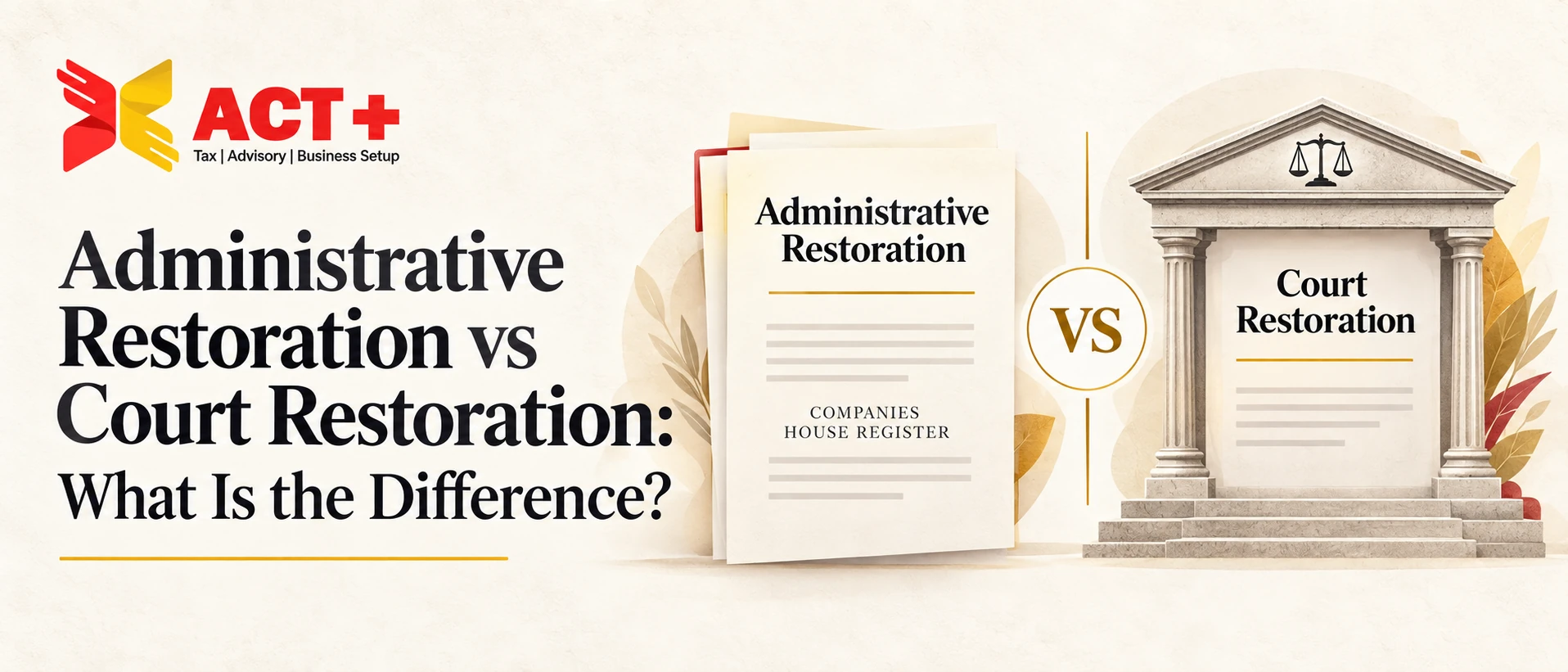
Court restoration requires a court order, while administrative restoration is decided directly by the Registrar of Companies.
The routes have different eligibility requirements and procedures.
| Feature | Court Restoration | Administrative Restoration |
|---|---|---|
| Decision maker | Court | Registrar of Companies |
| Applicant categories | Directors, members, creditors and other interested parties | Former directors or members |
| Voluntary strike-off | Court restoration can apply | Not available |
| England and Wales form | N208 | RT01 |
| Court proceedings | Required | Not required |
| Normal application limit | 6 years | 6 years |
| Creditor application | Available where eligible | Not available |
A director cannot choose either route without considering the statutory conditions.The correct route depends on the dissolution method, applicant and relevant legal requirements.Our administrative restoration guide explains the Registrar-based route separately.
Court restoration is required when the administrative route is unavailable or the applicant must seek a court order. Common cases include voluntary strike-off and creditor claims.
Yes. A person who was a creditor when the company was struck off or dissolved can apply under section 1029. Restoration does not automatically recover the debt.
Yes. Former directors and former members can apply for court restoration. Their circumstances determine the correct restoration route and supporting evidence.
A voluntarily dissolved company is normally restored through a court application. In England and Wales, the applicant normally uses form N208.
N208 is the Part 8 claim form used in England and Wales. It starts the restoration proceedings and is supported by the required evidence.
Court restoration has no fixed completion period. Timing depends on the court, service requirements, supporting evidence and any objections.See our company restoration timescales guide for more information.
Restoration after six years is limited to specific statutory exceptions. These include qualifying personal injury matters and certain refused administrative restoration applications.
The company returns to the register once the required order reaches Companies House. Section 1032 then determines the restoration's legal effect.
A court restoration application begins with the company's dissolution history and the applicant's legal position.The company number, dissolution date and strike-off method establish the starting point.The applicant's interest determines their standing under section 1029.The correct court procedure and supporting evidence must then be identified.
Company Restoration Uk can review the Companies House record and identify the company's restoration requirements. We can also assist with the accounting and compliance work connected with restoration.Court proceedings may require solicitor involvement or independent legal advice.
Need help restoring a dissolved UK company?
Send Company Restoration Uk the company name and Companies House number for an initial review.
Disclaimer:This article provides general information about UK court restoration. It does not constitute legal advice.

Specialists at Xact+ Accountants helping UK directors reinstate struck-off companies, meet Companies House and HMRC obligations, and recover frozen funds.
Speak to a restoration specialist today — most eligible companies are back on the register in 4–6 weeks.
Start restorationSend the basics. A case manager checks the register and comes back with the route, the documents and the official costs.
Start with how the company was dissolved.
These answers help estimate work and official costs.
We use these details only to prepare your email summary.
This is an indication from your answers, not a formal assessment.

Leave a comment