
Company restoration for overseas directors allows eligible former directors and shareholders to restore a dissolved UK company without visiting Britain. A non-UK resident director can manage restoration from abroad. However, the procedure depends on how Companies House dissolved the company, its outstanding filings, and the applicant's legal position. Overseas applicants must also consider identity verification, UK registered office arrangements, and international document delivery.
Administrative restoration requires form RT01 and supporting documents. Voluntarily dissolved companies normally require court restoration. This explains the requirements, official charges, paperwork, and practical steps for restoring a UK company while living overseas.
Yes. An overseas director can restore an eligible UK limited company without travelling to the UK. Companies House does not impose a general UK residency requirement for administrative restoration applicants. However, the former director or shareholder must satisfy the relevant conditions under the Companies Act 2006.
For ordinary Registrar strike-offs under sections 1000 and 1001, the main requirements include:
The applicant was a director or member when the company was dissolved.
The Registrar of Companies struck off the company.
The company was carrying on business or operating when struck off.
The application falls within six years of dissolution.
Outstanding documents, payments, and applicable Crown consent requirements are addressed.
Different conditions apply to certain strike-offs under section 1002A and regulation 22 of the Registered Office Address (Rectification of Register) Regulations 2024.
Section 1002A cases require evidence concerning the Registrar's grounds for strike-off. Regulation 22 cases require additional registered office evidence. Overseas applicants should establish the statutory reason for dissolution before preparing RT01.
Court restoration normally applies where directors voluntarily dissolved the company using form DS01. It also serves applicants outside the administrative restoration rules, including certain creditors and other interested parties.
Where administrative restoration is unavailable or refused, assess eligibility for a separate court restoration application. Any challenge to the Registrar's decision requires its own legal assessment. The usual court restoration application period is six years, subject to statutory exceptions.
Read our administrative restoration versus court restoration guide for the detailed differences.

Yes. An eligible overseas applicant can sign RT01 abroad and arrange postal delivery to Companies House.The application is not completed through an ordinary online restoration portal.
Follow the current Companies House application instructions:
Download and complete form RT01.
Check the applicant's eligibility and company information.
Sign the required declaration.
Prepare outstanding statutory accounts and paper confirmation statements.
Obtain the applicable Bona Vacantia waiver letter.
Arrange the prescribed application and filing payments.
Post the complete documents to Companies House.
The published postal address is
Companies House
Crown Way
Cardiff
CF14 3UZ
United Kingdom
An overseas applicant can coordinate delivery through a UK adviser or international courier. Check the current form's signing and payment instructions before sending the application. Do not assume an emailed scan replaces the prescribed postal documents.
Overseas directors must meet Companies House identity verification requirements when they hold a role covered by the legislation. Mandatory identity verification began on 18 November 2025.
Individuals can verify through GOV.UK One Login, where they have suitable identification. Alternatively, they can use an authorized corporate service provider (ACSP).An ACSP can verify eligible overseas individuals under the applicable Companies House rules.
A Companies House personal code is a unique 11-character code you receive after successfully verifying your identity. It belongs to you personally, and you must use it to connect your verified identity to each relevant company role.
Existing directors normally provide the code through their company’s confirmation statement. New directors provide it during incorporation or when filing their appointment. People with significant control (PSCs) must submit the code separately, following the reporting procedure and deadline for their circumstances. You use the same personal code across different companies.
Being eligible to apply as a former director does not automatically establish the individual's current verification obligations. The applicant's RT01 eligibility and the company's director verification duties are separate questions.Check the company's registered officers and PSCs, including any changes needed after restoration. Current directors must meet the applicable verification requirements for the confirmation statements being filed.
A UK company must maintain an appropriate registered office within its jurisdiction of incorporation. Its director can live overseas, but the company's registered office must remain in the relevant UK jurisdiction.
The address must receive official correspondence and allow delivery to be acknowledged. A Royal Mail PO Box alone does not satisfy these requirements.
Yes. The company can use an accountant's, solicitor's, or authorized service provider's address with permission. The provider must meet Companies House's appropriate-address rules.
A reliable UK correspondence address is particularly useful when directors no longer have access to their previous premises. The company must also maintain a registered email address for Companies House communications.
A company authentication code authorizes online Companies House filings. It consists of six alphanumeric characters and is separate from the individual's Companies House personal code. For eligible active companies, Companies House normally sends replacement authentication codes by post to the registered office.
No. Companies House excludes dissolved companies from its alternative home-address authentication-code service. This restriction matters when an overseas director has lost access to the former registered office.
Do not rely on the alternative service to obtain a replacement code before restoration. Contact Companies House about the available filing arrangements instead. An authentication code is not required simply to submit the paper RT01 application.
An overseas applicant must submit the statutory documents relevant to the company's restoration route.Additional identification or address evidence may be needed for verification, banking or court purposes.
Not every applicant needs every item.Companies House does not automatically require certified passport copies for every RT01 application.
Yes. Companies House requires paper form CS01 for outstanding confirmation statements submitted during restoration. Applicants must use the confirmation date due before strike-off. Where the correct date is uncertain, contact Companies House before completing CS01.
The published paper filing charge is £110, compared with £50 for an ordinary online confirmation statement. The confirmation statement fee operates within a 12-month payment period.
The charge is payable with the first statement in that payment period. Additional statements within the same period do not automatically attract another annual fee. For restoration cases involving several outstanding periods, calculate the payable charges against the relevant payment periods.
The current CS01 form includes Part 6 for directors' identity verification. Applicants must provide the required verification details for current directors unless Companies House already holds them.
Each relevant director must complete the applicable identity verification requirements and provide their personal code. This can affect restoration paperwork when outstanding confirmation statements require director verification details.
The Companies House RT01 application fee is £341.The published Bona Vacantia waiver charge is £64 under the applicable procedure.
For illustration, one chargeable paper, CS01, plus RT01 and the applicable waiver produces £515 in official charges.This excludes other outstanding filings, penalties and professional fees.
Penalties depend on when the accounts became overdue. Unpaid penalties from accounts delivered late before dissolution remain payable. Accounts already overdue when the company dissolved can attract penalties when delivered on restoration.
However, Companies House does not impose late-filing penalties for accounts that first became due while the company was dissolved, when delivered on restoration. Review each accounting period separately rather than assuming every overdue set of accounts attracts a penalty.

A former director lives in Dubai. Companies House dissolved the director's UK company two years ago following missed filings. The company was operating when the Registrar struck it off. The director also lost access to the former UK registered office.
A UK accountant reviews the dissolution history and confirms the ordinary administrative restoration conditions. The accountant prepares the outstanding accounts and paper CS01 documents. The director completes the required identity verification, while the accountant checks the registered office arrangements. Because the company remains dissolved, the director cannot use the alternative home-address service to request an authentication code.
Instead, the restoration proceeds through the prescribed paper filing process. The director signs RT01 in Dubai, and the completed pack reaches Companies House by courier. Companies House then assesses the application and supporting documents. This illustrative example does not guarantee acceptance. The actual requirements depend on the company's records and statutory position.
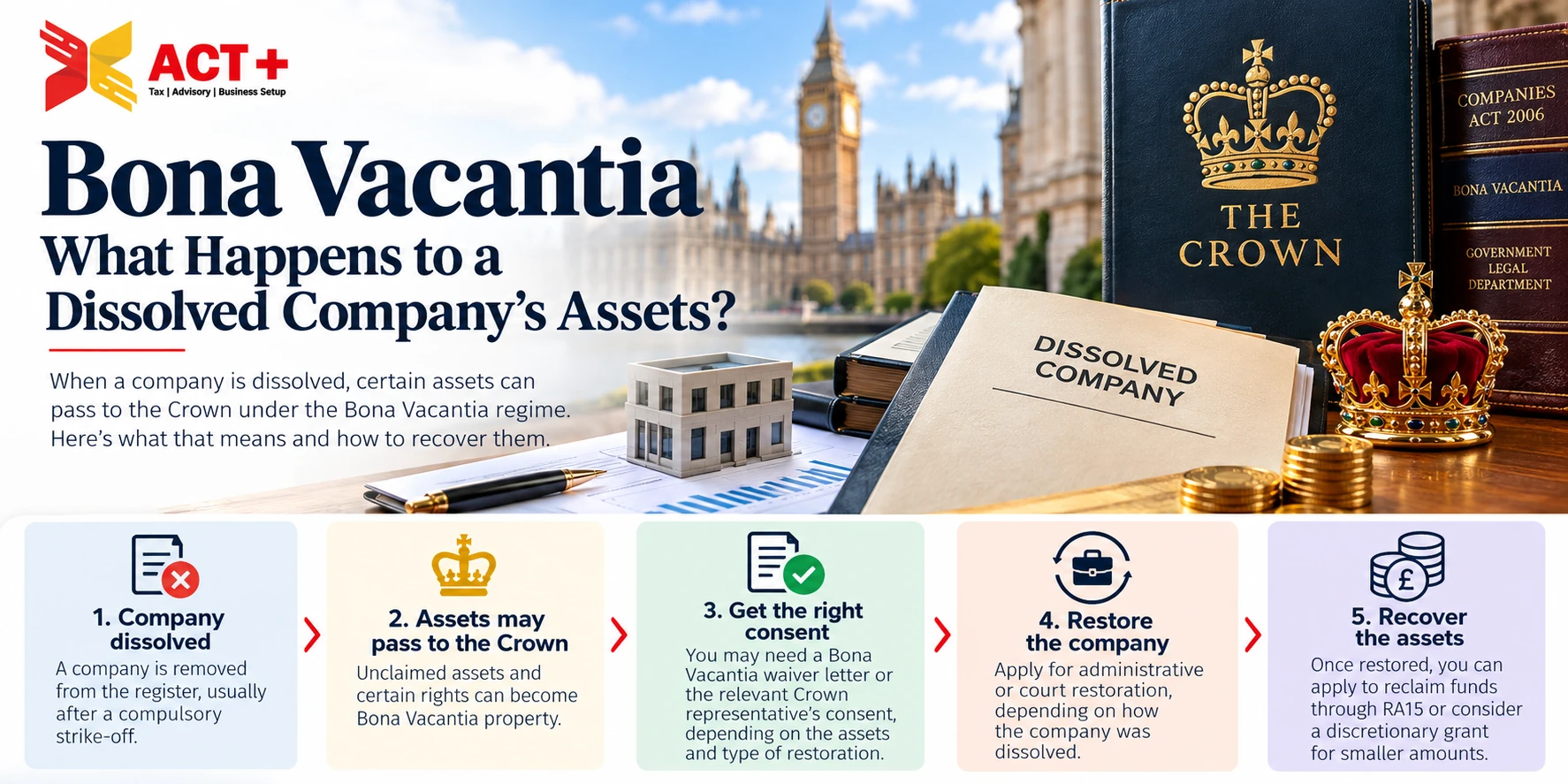
An overseas director can coordinate the recovery of a restored company's frozen funds without automatically travelling to Britain. Company money may pass to the Crown as bona vacantia following dissolution. After restoration, the company can seek repayment from the organization holding the balance.
Banks may require restoration evidence, director identification, and further compliance checks. Where qualifying cash passed to the Government Legal Department's Bona Vacantia Division, the RA15 repayment procedure may apply.
Restoration can bring outstanding Companies House and HMRC obligations back into focus. Companies House filings and Corporation Tax requirements are separate. Review the company's trading history, financial statements, HMRC correspondence, and outstanding tax returns. An overseas director's residence does not automatically determine the company's tax residence. Where management and control occur outside the UK, separate treaty and overseas tax questions may arise.
A UK accountant can coordinate restoration records, outstanding accounts, Crown consent, and Companies House correspondence. An ACSP may separately handle identity verification where authorised. Court restoration may require legal assistance under the relevant court procedures. Ask the adviser for a written quotation distinguishing official charges from professional services. Confirm who prepares the documents, who signs them and whether bank fund recovery is included. Company Restoration UK can review the dissolution history and outstanding filings before identifying the restoration route.
Certification requirements depend on the authority receiving the documents. An ACSP may request approved identification. Banks may request certified passports or address documents for repayment checks. Court evidence may require formal witnessing or other procedural steps. An apostille is not automatically necessary for every RT01 application. Check the receiving organization's document requirements before arranging certification, translation, or notarization.
Yes. A former shareholder living abroad can apply for administrative restoration if the company meets the statutory conditions. The registrar must normally have struck off the company within the previous six years. Voluntarily dissolved companies generally require court restoration.
Yes. An eligible former director or shareholder can sign RT01 outside the UK. The applicant must complete the prescribed declaration and post the application to Companies House with the required documents and fees. Overseas residence does not prevent a valid application.
Yes. A UK limited company can have directors who all live outside the United Kingdom. However, it must appoint at least one natural-person director, maintain an appropriate UK registered office, and meet its statutory filing obligations.
No. Companies House does not require a company authentication code to submit RT01. Administrative restoration uses a paper application. The six-character authentication code authorizes online filings and serves a different purpose.
Yes. Current directors must provide their Companies House personal codes through the applicable identity verification section of paper CS01, unless Companies House already holds the required information. Part 6 covers director verification. Former directors applying for restoration must distinguish their applicant status from current company roles.
Companies House does not charge late-filing penalties for accounts that first became due while the company was dissolved, when delivered on restoration. However, penalties can apply to accounts already overdue before dissolution. Any unpaid pre-dissolution penalties also remain payable.
Yes. An overseas director can coordinate the recovery of company funds after restoration. If the bank retains the balance, it may release the money following its checks. Where the Government Legal Department's Bona Vacantia Division holds qualifying funds, an RA15 repayment application may be required.
Company restoration for overseas directors normally requires no visit to the UK. Start with the dissolution date, strike-off reason, and outstanding filing history. These determine the available restoration route and documents.Before submitting RT01, check paper CS01 requirements, identity verification, UK correspondence, and applicable fees. Provide Company Restoration UK with the company number and dissolution details for an initial eligibility review.

Specialists at Xact+ Accountants helping UK directors reinstate struck-off companies, meet Companies House and HMRC obligations, and recover frozen funds.
Speak to a restoration specialist today — most eligible companies are back on the register in 4–6 weeks.
Start restorationSend the basics. A case manager checks the register and comes back with the route, the documents and the official costs.
Start with how the company was dissolved.
These answers help estimate work and official costs.
We use these details only to prepare your email summary.
This is an indication from your answers, not a formal assessment.



Leave a comment