You can recover payment platform funds after company dissolution when the restored company establishes its right to payment and satisfies the provider's release requirements. Restoration alone does not cancel account restrictions, refunds, or reserves.
Amazon, Stripe, PayPal, Wise, and Shopify hold or process money through different arrangements. A dashboard balance may include unsettled receipts, withheld reserves or transfers already sent to a bank. Identify the actual amount payable before starting a recovery request.
Check the company status, the provider's latest notice, and its settlement statement. Use the account's payout reference when corresponding with support.
Keep account statements, correspondence, and payout references. These records also support the company's overdue accounts.
To recover Amazon seller funds after company dissolution, identify whether Seller Central has suspended selling, restricted disbursements, or retained a reserve. Check payments, account health, and the deactivation notice.
Amazon's published UK funds-withholding guidance permits a separate disbursement request after 90 days if an appeal did not reinstate the account or the seller chose not to appeal. This is not a general release deadline for all payment holds.An account reinstatement appeal concerns permission to resume selling. A disbursement review concerns eligibility to receive withheld proceeds. Amazon may investigate possible abusive or fraudulent activity and request identification, financial instrument, or product-sourcing evidence.
Amazon's UK guidance names disbursement-appeals@amazon.co.uk for the relevant process. Follow the notice for your particular account. Outstanding returns, A-to-Z Guarantee claims, seller fees and other permitted deductions may reduce or prevent payment.After restoration, provide the company's updated registration and authorised representative details if Amazon requests them. Ask for a settlement breakdown, not simply release of the dashboard total.
To recover Stripe funds after company dissolution, check the Balances and Payouts records. Distinguish available funds from pending payments, disputes and transfers already initiated.
Changing bank details does not reroute a payout already in transit. A closed receiving bank may reject it and return the money to Stripe. Stripe's support guidance describes a return of up to five business days for the relevant failed-payout circumstances. This is not a guarantee for every receiving bank.
Record the payout ID, bank destination and current status. Ask the receiving bank whether it rejected the transaction. Once a return appears in Stripe, complete any outstanding verification before arranging another payout.
A Stripe Connect merchant may need to contact the connected platform where that platform controls payouts. Disputes and reserves remain subject to Stripe's applicable terms.
To recover PayPal funds after company dissolution, review the Resolution Centre and separate available money from holds and reserves. Account limitations may arise from verification failures, disputes or transaction risks.
A hold restricts an individual payment. A rolling reserve retains a specified proportion of qualifying transactions for a period. A minimum reserve requires an agreed balance to remain available to PayPal.For example, if a 10% rolling reserve covers all £5,000 of qualifying receipts, £500 would be retained. This is a hypothetical contract term, not PayPal's standard rate.After restoration, provide current business and ownership information if requested. Obtain written confirmation of the available balance, outstanding disputes and reserve release terms. Do not assume funds become payable automatically after 180 days.
You may recover Wise funds after company dissolution by establishing whether the money is a remaining Wise Business balance or an individual transfer requiring a refund.
No. Wise says customers usually have 90 days from its initial closure email to move their remaining money. This is a pre-closure withdrawal window, not a guaranteed refund-processing time. The relevant notice controls the actual closure date and available actions.
If the account remains active during that window, eligible money may be sent to an external account. After deactivation, Wise may require a balance-refund request and external bank details. Security checks, currency conversion, and receiving-bank arrangements may affect the timing.
A closed-account balance refund differs from reversing a pending transfer. Wise publishes separate handling and timings for pending transfer refunds. Confirm which process concerns the company's funds.
Wise's general guidance does not require Companies House restoration for every closure refund. Where the company has dissolved, however, the applicant must establish legal authority. Wise may request restoration confirmation, ownership evidence, and a verified receiving account.

For Shopify, identify whether Shopify Payments or an outside processor actually controls the settlement. A shop's order total is not necessarily its payout balance.
Shopify restricts certain payout-hold information and actions to the store owner. Staff may receive an alert without access to the detailed verification request. Review the admin notice and owner email. If the original owner has left, ask Shopify Support about the appropriate ownership and access process. Supply restored company documents where requested. For eBay, Etsy, or other marketplaces, request the actual processor's settlement records and account notice. Identify refunds, fees, and amounts retained against potential liabilities.
The Companies House strike-off history determines the route, not the merchant's payment provider. Eligible former directors or members may request administrative restoration using RT01 after qualifying Registrar strike-offs. Ordinary cases require the company to have been carrying on business or operating when struck off. The usual limit is six years; special strike-off categories have different conditions.
The published RT01 fee is £341. The applicable Government Legal Department Bona Vacantia waiver procedure has a £64 charge. Outstanding statements, accounts, and penalties may add costs. Companies voluntarily struck off through DS01 normally require court restoration. Court procedures and costs differ.
Read the UK company restoration guide for statutory eligibility and filing procedures.
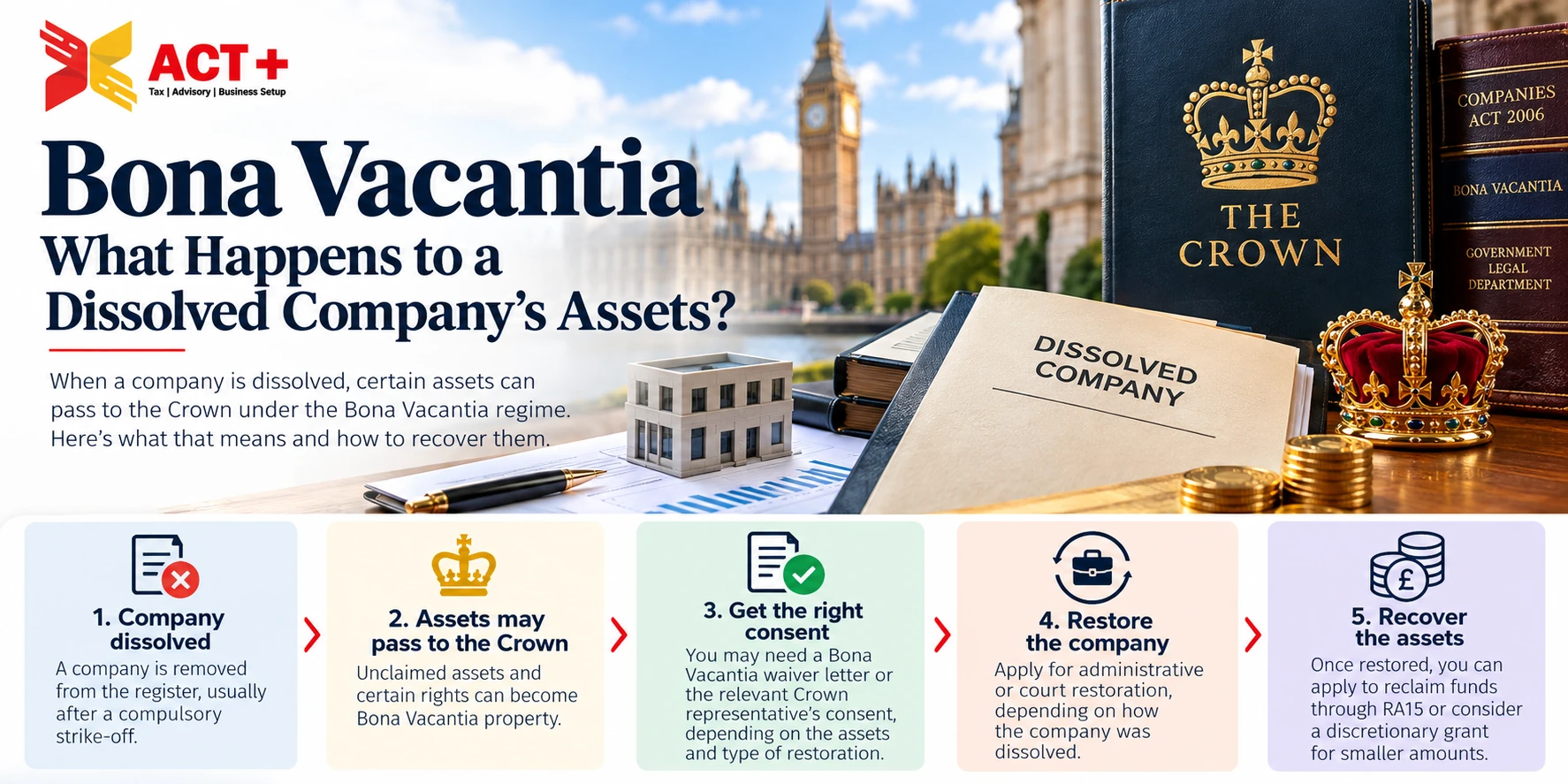
No. Company property and contractual rights may pass to the Crown as bona vacantia, but this does not prove that a provider transferred cash to a Crown representative.A merchant might hold a contractual claim to future settlement, subject to charges, reserves, and refunds. Ask the provider whether it retains the balance, owes a payment, or has transferred any funds to the Crown.The Government Legal Department's RA15 procedure concerns qualifying cash actually received or collected by its Bona Vacantia Division. It is not a general application for money withheld by Amazon or Wise.
See the Bona Vacantia guide for Crown ownership rules.
Providers may ask for proof of restoration and authority to receive the company's funds.
The provider may also require transaction, inventory, or sourcing information. Upload sensitive documents through verified account channels.
Reconcile customer receipts, refunds, provider fees, held reserves, and completed bank payouts separately. Gross sales are not the same as available cash.
The calculation assumes no other adjustments or disputes.
A reserve may remain an asset where the company retains an enforceable contractual right to payment. Classify the balance under the applicable accounting framework and consider whether it is restricted. A temporary hold is not automatically a trading expense.
Account separately for refunds, fees and chargebacks. Assess disputed or unrecoverable receivables for impairment or other adjustment. Determine VAT from the underlying supplies and credit notes rather than the net transfer received.
For ordinary deposits rather than merchant settlements, read our dissolved company bank account recovery guide.
Possibly. The provider decides whether to reopen an account under its contract and verification policies. Restoration alone does not reverse Amazon seller deactivation, PayPal limitations or Wise closure decisions.
Where reinstatement is refused, ask for the formal procedure to receive an eligible remaining balance. A company can sometimes recover money without resuming use of the same payment account.
Match the received amount to the final settlement report. Record fees, refunds and reserves that explain the difference between gross receipts and payment received.
Keep payout references, banking evidence and correspondence. Check outstanding tax, suppliers and other company liabilities before distributing funds to directors or shareholders.
Yes. A restored company may seek eligible proceeds through Amazon's applicable appeal and disbursement processes. An unsuccessful reinstatement appeal, or a decision not to appeal, may permit a separate funds review after 90 days under the stated policy. That review does not guarantee release.
Yes. Stripe may release eligible funds after company verification and banking requirements are resolved. Existing disputes, reserves and returned payouts need separate review.
Yes, subject to account restrictions and PayPal's reserve terms. Restore the company as necessary, then identify the available balance and the conditions for releasing held amounts.
Yes. Wise may refund an eligible remaining balance after closure following security and receiving-bank checks. A closed balance refund is different from a pending transfer refund; the 90-day closure window is not the refund deadline.
Eligible Registrar strike-offs normally use administrative restoration. Voluntary dissolutions generally require a court application. The provider holding the funds does not change the company's statutory route.
Providers may request restoration confirmation, current officer identification, company ownership records, historic statements and receiving bank details. Additional documents depend on the reason for the restriction.
Sometimes. The payment provider must independently approve reactivation. Ask for a remaining-balance repayment procedure if the company has been restored but its merchant account cannot reopen.
To recover payment platform funds after company dissolution, obtain the account notice and detailed settlement statement. Confirm the amount payable, identify the company's restoration route and respond to the provider's verification requirements.
Amazon, Stripe, PayPal, Wise and Shopify use different release procedures. Contact Company Restoration UK with the company number, provider name and balance details to assess the restoration work involved.

Specialists at Xact+ Accountants helping UK directors reinstate struck-off companies, meet Companies House and HMRC obligations, and recover frozen funds.
Speak to a restoration specialist today — most eligible companies are back on the register in 4–6 weeks.
Start restorationSend the basics. A case manager checks the register and comes back with the route, the documents and the official costs.
Start with how the company was dissolved.
These answers help estimate work and official costs.
We use these details only to prepare your email summary.
This is an indication from your answers, not a formal assessment.



Leave a comment