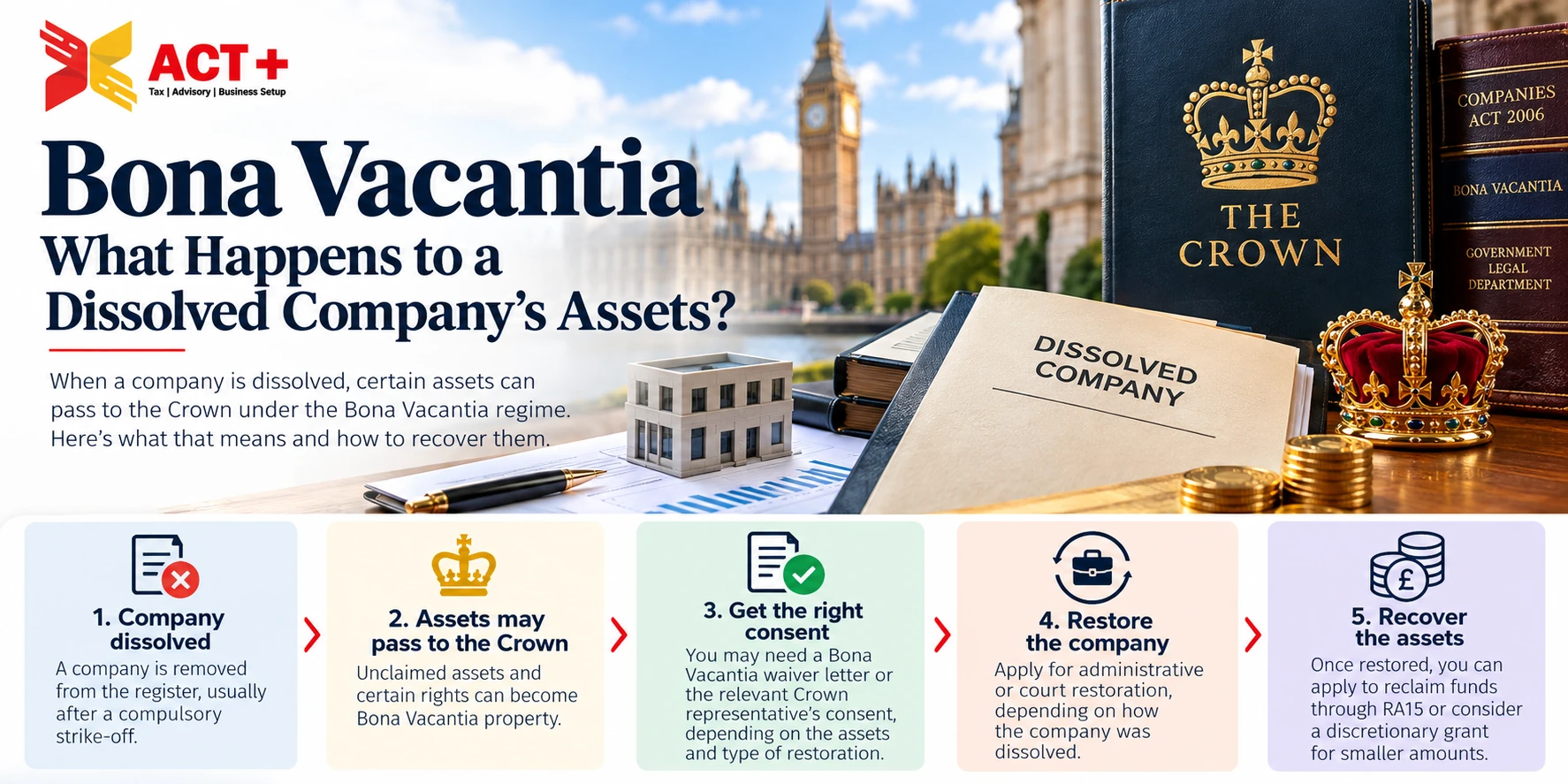
Bona Vacantia is the legal process through which a dissolved company's remaining assets pass to the Crown. These assets can include business bank balances, land, shares, and intellectual property.Under Section 1012 of the Companies Act 2006, a company generally loses ownership of its remaining property when dissolution takes effect.
Former directors and shareholders cannot automatically reclaim that property. They may need to restore the company, obtain Crown consent, or follow a separate asset recovery procedure.This explains the Bona Vacantia rules for dissolved companies, waiver requirements, restoration eligibility, official costs, and repayment procedures. It also explains when former shareholders can recover funds without restoring the company.
Bona vacatia means ownerless property that passes to the Crown under UK law. When Companies House dissolves a limited company, its remaining property and rights generally become Bona Vacantia. The company no longer has a separate legal existence. Its former directors and shareholders do not automatically inherit its assets. The Bona Vacantia Division (BVD), part of the Government Legal Department, handles qualifying Crown assets within its jurisdiction. Different Crown representatives deal with assets in Scotland, Northern Ireland, and certain areas of England. The legal position comes from the Companies Act 2006.
Bona Vacantia can prevent former company officers from accessing assets held in the dissolved company's name. For example, a company might have £15,000 in its business bank account when Companies House dissolves it.Its former director cannot withdraw that money for personal use.Restoring the company may provide a way to reclaim the balance. The correct procedure depends on whether the bank still holds the funds.
Property and rights owned by the company at dissolution generally pass to the Crown.The rules cover both physical assets and financial interests.
The Government Legal Department explains the treatment of different assets in its BVC1 guidance.
Banks commonly freeze or close accounts when they discover that a company has been dissolved.The bank may retain the money temporarily or transfer it to the appropriate Crown representative.Where the bank still holds the balance, the restored company normally deals directly with the bank.Where the Bona Vacantia Division has collected the funds, a separate repayment application may be necessary.
No. Bona Vacantia generally concerns property and rights belonging to the dissolved company.Assets belonging to another person do not automatically pass to the Crown.For example, machinery held under a genuine equipment-hire agreement may belong to the hire company.Directors should review contracts, property records and financial statements to establish ownership.
A Bona Vacantia waiver letter is written consent from the relevant Crown representative for a company's administrative restoration. It confirms the Crown representative's consent to restoration under the applicable statutory requirements. A waiver does not itself restore the company. Companies House must still accept the restoration application.
The Treasury Solicitor issues relevant waiver letters through the BVC14 application procedure. A waiver letter and an asset repayment are different documents. The waiver supports restoration. A repayment application concerns money already collected by the Crown.
A Bona Vacantia waiver or written Crown consent is required for administrative restoration where a dissolved company's property or rights became Bona Vacantia. The Government Legal Department describes Crown consent as part of administrative restoration. However, its BVC14 procedure applies only to qualifying companies within the Treasury Solicitor's jurisdiction.
If the company held no assets or rights when dissolved, applicants should confirm the consent requirements with Companies House and the relevant Crown representative. An asset-free company should not automatically be treated as requiring a Treasury Solicitor BVC14 application. Applicants should establish whether relevant property or rights existed at dissolution before deciding which consent procedure applies.
The absence of company assets can affect whether Crown consent is needed.For example, a dissolved company may have closed its bank account and disposed of its equipment before dissolution.
However, a nil bank balance does not always prove that the company owned nothing.Outstanding refunds, shares, intellectual property or contractual rights may still exist.Applicants should check the relevant records and confirm any consent requirements before submitting Form RT01.
A former director or member can apply for administrative restoration if the company meets the statutory conditions.
For a company struck off under Sections 1000 or 1001 of the Companies Act 2006, the main conditions include:
The applicant was a director or member when the company was struck off or dissolved.
Companies House struck off the company rather than the directors voluntarily applying for dissolution.
The company was carrying on business or in operation when struck off.
The application is made within six years of dissolution.
Outstanding statutory filings, applicable fees and penalties are addressed.
Written Crown consent is obtained where required.
There are additional statutory routes for companies struck off under Section 1002A and Regulation 22 of the Registered Office Address (Rectification of Register) Regulations 2024.
These routes have different qualifying conditions. The usual trading or operating requirement should not be applied to them without checking the specific legislation.
Court restoration has a separate Crown consent and non-objection procedure.Applicants in England and Wales generally serve the appropriate Crown representative with the restoration documents.
The court normally requires written confirmation that the solicitor handling the Bona Vacantia assets does not object.For a voluntarily dissolved company, the Government Legal Department directs relevant enquiries to its litigation team for a court restoration waiver letter.
Crown representatives may also claim applicable costs connected with assets handled during dissolution.The BVC14 administrative procedure should not be used automatically for court restoration.The requirements depend on the dissolution circumstances, relevant jurisdiction and court procedure.
To apply for a Bona Vacantia waiver, check the company's eligibility, identify its assets and contact the correct Crown representative.Qualifying Treasury Solicitor applications use Form BVC14.
Search the Companies House register using the company name or registration number.Confirm the dissolution date, reason for strike-off and last registered office.These details help establish whether administrative restoration is available.
Check where the company's registered office and assets were situated.The Treasury Solicitor handles qualifying applications within its jurisdiction.Companies associated with the Duchies of Lancaster or Cornwall may need a different representative.Separate procedures apply in Scotland and Northern Ireland.
Download the current BVC14 form from waiver letter guidance.Provide the requested company and applicant details.Check the completed form against Companies House records to avoid inconsistencies.
Send the application to the Bona Vacantia Division using the submission details in the official guidance.The Treasury Solicitor charges £64 for the application.Payment is made through the approved bank transfer arrangements.Use the company registration number as the payment reference.
The Government Legal Department aims to process complete applications within 20 working days.Missing documents, payment problems and unpaid asset-related costs may delay approval.After receiving the letter, include it with Form RT01 and the required supporting documents.The Treasury Solicitor does not submit the waiver to Companies House on the applicant's behalf.
The Treasury Solicitor charges £64 for a BVC14 waiver application.Companies House restoration fees, outstanding filings and professional charges are separate.
The £64 charge comes from Government Legal Department guidance. Companies House confirmed the £341 RT01 fee in its February 2026 update.
A director discovers that a dissolved company had £8,000 remaining in its bank account.The company qualifies for administrative restoration and needs Treasury Solicitor consent.The director pays £64 for BVC14 and £341 for RT01.The combined application charges are £405, excluding other costs. Recovering the £8,000 does not reduce those charges. The company must still deal with outstanding filings.
The waiver application requires the completed form and relevant company details.The subsequent restoration application generally requires outstanding documents and applicable payments.Where Crown consent is necessary, include the appropriate waiver letter.Applicants should retain the company's financial records and evidence of asset ownership.
The correct Crown representative depends on the company's jurisdiction and the location of its property.The Government Legal Department does not handle every dissolved company's assets.
Farrer & Co handles relevant Bona Vacantia matters for the Duchies of Lancaster and Cornwall.The correct authority should be identified before submitting a waiver application.
For example, a company previously registered in Lancashire may fall within Duchy of Lancaster jurisdiction.Sending its waiver application to the Treasury Solicitor without checking jurisdiction could delay restoration.
Land and buildings owned by a dissolved company generally pass to the Crown when dissolution takes effect.Former shareholders cannot sell or transfer that property merely because they previously controlled the company.
A dissolved company might own a commercial property worth £180,000.Its shareholders cannot divide that property between themselves after dissolution.Restoring the company may return its legal interest, provided the Crown has not disposed of the property or disclaimed it.
Yes. The Crown may dispose of or disclaim qualifying property under the relevant legal rules.A disclaimer formally ends the Crown's interest in specified property. Its consequences depend on the type of asset.A Crown sale creates a different problem.If the Crown sells an asset before restoration, the restored company cannot simply demand its return from the purchaser.
The company may instead become entitled to the sale proceeds, subject to applicable statutory rules and costs.Property owners should establish whether the Crown has already dealt with the asset before beginning recovery proceedings.
Company restoration generally returns the company to its former legal position, subject to statutory exceptions.Property remaining vested in the Crown can revest in the restored company.However, recovery depends on what happened to the assets during dissolution.For example, the Crown may already have collected a bank balance, sold property or disclaimed a legal interest.Each situation requires the appropriate recovery procedure.
A restored company can use Form RA15 to apply for repayment of qualifying cash held by the Bona Vacantia Division.The company must first return to the Companies House register.The funds must also have been referred to BVD by a third party, such as a bank.Where the money remains with the bank, the applicant should deal with the bank instead.
The Government Legal Department permits applications from:
Company directors
Company secretaries
Creditors
Insolvency practitioners
Liquidators
An eligible applicant can request repayment to the restored company or, where permitted, an authorised third party.The application requires the relevant supporting documents, including proof of restoration and bank details.BVD does not charge for RA15 applications or deduct a repayment fee.Complete applications can take up to 20 working days to process.
Repayments above £10,000 trigger additional anti-money laundering checks. Identity checks apply to the person signing the RA15 application, the majority of company officers and shareholders holding at least 25% of the shares. Payments to third-party accounts may require identity evidence even below £10,000. Applicants should check the current documentation requirements before submitting the request.
Yes. Certain applicants can recover Crown-held money without restoring the dissolved company. The Government Legal Department operates discretionary grant arrangements for qualifying applications. Other assets may be available for purchase from the Crown. These alternatives have different eligibility requirements and financial consequences.
The DG2 scheme allows qualifying applicants to request a discretionary payment without restoring the company.For companies that remain eligible for restoration, the maximum grant is £3,000.Eligible applicants include former shareholders, subject to the scheme's conditions, and certain former insolvency office-holders.Where shareholders apply, all former shareholders must participate and the company must have no existing creditors.Applicants must also undertake not to restore the company in future.The Crown does not have to approve a discretionary grant.
BVD deducts a £300 administrative charge from the balance.Where the remaining amount exceeds £750, BVD applies a further 5% reservation deduction.Consider a dissolved company with £2,300 already transferred to BVD.
The calculation follows the official DG2 example.
The applicant receives £1,900 rather than the full £2,300, assuming approval and no other applicable adjustments.This distinction matters when comparing a discretionary grant with company restoration.For larger balances, restoration may provide a more appropriate recovery route, depending on the company's liabilities and circumstances.
Yes. An interested party may be able to purchase qualifying property from the relevant Crown representative.Assets could include shares, intellectual property or land.The Crown generally seeks market value where it agrees to sell.A former shareholder has no automatic right to buy the property at a discount.Purchasing an asset also does not restore the dissolved company.
Yes. A creditor may apply for court restoration where the legal conditions are met. After restoration, an eligible creditor can also apply through RA15 for qualifying BVD-held funds.
The restored company should contact the bank directly. RA15 repayment applies only when the Bona Vacantia Division has received the relevant funds.
Yes. The Crown may sell qualifying assets under the applicable rules. Restoration does not automatically reverse a completed sale.
No. Companies House must still assess the RT01 application, supporting documents, statutory eligibility and applicable payments.
No. DG2 limits recovery to £3,000. Larger balances may require restoration or another procedure, depending on the circumstances.
No. Administrative restoration is unavailable where the directors voluntarily applied to strike off the company. Court restoration is generally the relevant route.
Bona Vacantia affects property and rights left behind when a UK company is dissolved. Bank balances, land, shares and intellectual property may pass to the Crown.
Company restoration can provide a route to reclaiming those assets. However, applicants must check the restoration requirements, relevant Crown consent and any separate repayment procedures.
Former shareholders may also qualify for discretionary grants without restoring the company.Before starting, confirm the dissolution details, identify the remaining assets and establish which authority holds them. This helps determine the appropriate recovery route and the likely costs.

Specialists at Xact+ Accountants helping UK directors reinstate struck-off companies, meet Companies House and HMRC obligations, and recover frozen funds.
Speak to a restoration specialist today — most eligible companies are back on the register in 4–6 weeks.
Start restorationSend the basics. A case manager checks the register and comes back with the route, the documents and the official costs.
Start with how the company was dissolved.
These answers help estimate work and official costs.
We use these details only to prepare your email summary.
This is an indication from your answers, not a formal assessment.




Leave a comment