You can stop compulsory strike-off before dissolution by identifying why Companies House started the proceedings, correcting the underlying compliance problem and responding to the Registrar. Directors may need to file overdue accounts, submit an outstanding confirmation statement, correct the registered office or provide evidence that the company remains operational.Directors can address the company's outstanding compliance requirements. Creditors, shareholders, and other interested parties may also object to compulsory strike-off where they have valid grounds and supporting evidence. Formal objections can be submitted after the proposed strike-off has been advertised in The Gazette.
Act promptly after receiving a strike-off notice. Ordinary compulsory strike-off generally involves a minimum two-month Gazette notice period, although certain expedited procedures have a minimum period of 28 days. Submitting documents does not automatically stop strike-off. Companies House must accept the relevant filings and formally discontinue the proceedings.
Check the company's status, review the latest Companies House correspondence and establish why the Registrar has started strike-off proceedings.
Follow these six steps:
Check the company register. Search using the company name or registration number to confirm its current status.
Read the strike-off notice. Identify the Gazette publication date, legal grounds and relevant deadline.
Find the compliance problem. Check overdue accounts, confirmation statements, registered office details and unanswered enquiries.
Take corrective action. Submit the required documents, update inaccurate information or provide evidence requested by the Registrar.
Respond to Companies House. Explain the steps taken and provide supporting information where necessary.
Confirm discontinuance. Check that the filings were accepted and the Registrar has discontinued compulsory strike-off, commonly recorded as DISS40.
Use the official Companies House company search to inspect the filing history.
A registered office problem may require action within a separate 28-day period. Always follow the deadline relevant to the particular enforcement procedure.
Companies House may initiate compulsory strike-off when the Registrar has reasonable grounds to believe that a company is no longer carrying on business or operating.
Repeated failure to submit statutory filings or respond to official enquiries may cause the Registrar to question whether the company remains active.
Separate enforcement powers apply where a company appears to have been registered on a false basis or has failed to maintain an appropriate registered office.
The corrective action must relate to the actual reason for strike-off. Filing accounts alone does not necessarily resolve an unrelated enforcement problem.
Directors should identify every outstanding accounting period, prepare the appropriate statutory accounts and deliver them to Companies House.
Limited companies generally need to file annual accounts even if they have stopped trading or are dormant.For example, if accounts for the year ended 31 December 2024 remain overdue, filing the following year's accounts does not remove the earlier filing obligation.
The company may need:
Business bank statements for the relevant periods.
Sales invoices and income records.
Expense receipts and bookkeeping records.
Asset and liability balances.
Director loan account information.
Previous statutory accounts.
Details of outstanding creditors and debtors.
The accounts format depends on the company's size, financial position and applicable reporting rules.Eligible companies may prepare micro-entity or dormant accounts. Other companies may require fuller statutory accounts.
Companies House accepts different filing methods according to the accounts type.Eligible dormant and micro-entity accounts can use specified Companies House online services. Some full, audited and specialist accounts require commercial software or another permitted filing route.
Before submitting an urgent filing, check that the selected service accepts the required accounts and that the company's authentication code is available where needed.
From 1 April 2028, Companies House will require annual accounts to be filed using commercial software in iXBRL format. The current web and paper accounts filing routes will close under those reforms.
This change concerns Companies House accounts. Confirmation statements and certain other statutory updates will continue to have separate filing arrangements.
No. Filing overdue accounts does not automatically remove Companies House late filing penalties. Penalties already incurred may remain payable after the accounts are accepted. Directors should also check whether other statutory documents are missing. Acceptance of the accounts does not automatically discontinue strike-off proceedings.
A company must generally file at least one confirmation statement every 12 months, within 14 days after the end of its review period. An overdue confirmation statement can lead to enforcement action, financial penalties, and possible compulsory strike-off. Before filing CS01, review the registered office, registered email address, directors, shareholders, people with significant control, and applicable SIC codes. Some changes must be submitted separately before the confirmation statement is filed.
Yes. All company directors must verify their identity before Companies House will accept the company's confirmation statement. Each director receives a unique Companies House personal code after completing identity verification.
Before submitting CS01, check that:
Every director has completed Companies House identity verification.
The required personal codes have been provided for the directors.
The company authentication code is available for the relevant filing service.
The company's registered information is correct.
Any people with significant control have met their separate identity verification requirements and deadlines.
A director's personal code is different from the company authentication code. Companies House will not accept the confirmation statement until all directors have verified their identities.
As of November 2026, the annual Companies House confirmation statement fee is:
The 12-month payment period differs from the confirmation statement review period.The annual fee is payable with the first confirmation statement filed during the payment period. A further statement submitted within the same payment period does not automatically attract another annual fee.Filing CS01 does not guarantee discontinuance. Directors must confirm the Registrar's decision separately.
A company must maintain an appropriate registered office address within its UK jurisdiction of incorporation. The address must allow correspondence to reach someone acting on the company's behalf and permit delivery to be acknowledged. An ordinary PO Box is not an acceptable registered office address.
Where the registrar replaces an unsuitable registered office with a Companies House default address, the company generally has 28 days to register a replacement appropriate address, subject to applicable appeal provisions.
The company must also provide evidence that it owns the property or has permission to use the proposed address. Failure to meet the requirement can lead to compulsory strike-off. The 28-day registered office correction period is separate from the Gazette notice period.
Directors should respond promptly to the registrar and provide evidence addressing the specific grounds for strike-off. A response should include the registered company name, company number, relevant correspondence reference, and details of corrective action.
If Companies House has raised concerns about false registration information, the response must address those specific concerns. Ordinary accounts or confirmation statement filings may not be sufficient.
No. A filing acknowledgement confirms that Companies House has received or recorded the submission. The Registrar may reject a document or request additional evidence.Directors should confirm that the required documents have been accepted and that compulsory strike-off has formally been discontinued.
Ordinary compulsory strike-off proceedings generally allow at least two months after the first Gazette notice before dissolution. Certain expedited procedures, including specified false-registration cases, allow a minimum period of 28 days.
These are statutory minimum periods, not guaranteed additional time for directors to delay corrective action.
Yes. Creditors, shareholders and other interested parties may object after a proposed strike-off notice has appeared in The Gazette.
An objection must have a valid basis and supporting evidence. For example, a creditor may submit unpaid invoices, a contract or evidence of an outstanding legal claim. An accepted objection can delay strike-off proceedings, but it does not automatically settle the company's liabilities.
Companies House formally discontinues compulsory strike-off when the Registrar ends the current proceedings.The public filing history commonly records this outcome using document code DISS40.Directors should distinguish discontinued action from a temporary suspension.
DISS40 confirms discontinuance of the current proceedings. It does not prove the company has no debts, unpaid tax, late filing penalties or future filing obligations.
The public Companies House filing history for DRAMAND LIMITED (11273680) records the following events:
The filing history confirms these recorded events and their sequence. It does not establish the Registrar's complete reasoning or guarantee that another company will achieve the same outcome or processing time.
Companies House filings and HMRC tax obligations must be addressed separately. A company may have outstanding Corporation Tax, VAT, or PAYE returns even after Companies House has accepted its statutory accounts. Paying HMRC does not automatically stop a registrar-led strike-off. Likewise, submitting overdue accounts does not clear outstanding tax returns or liabilities.
The former joint online accounts and company tax return filing service closed on 31 March 2026. Companies generally use commercial software to submit HMRC company tax returns, while Companies House has its own applicable accounts filing routes.If the company cannot pay debts as they fall due, directors should consider appropriate insolvency advice.
Once Companies House has dissolved a company, directors cannot ordinarily reverse the completed strike-off simply by submitting overdue accounts or a confirmation statement. The appropriate route may be administrative restoration or court restoration.
Under the ordinary administrative restoration route, the principal eligibility conditions include:
The applicant was a director or shareholder of the dissolved company.
The Registrar struck off the company within the previous six years.
The company was trading when it was dissolved.
The applicant meets the applicable statutory requirements.
Companies struck off under certain special Registrar powers, including false-registration or registered office enforcement provisions, may be subject to modified eligibility conditions or additional evidence requirements.Check the original grounds for dissolution before choosing the restoration procedure.
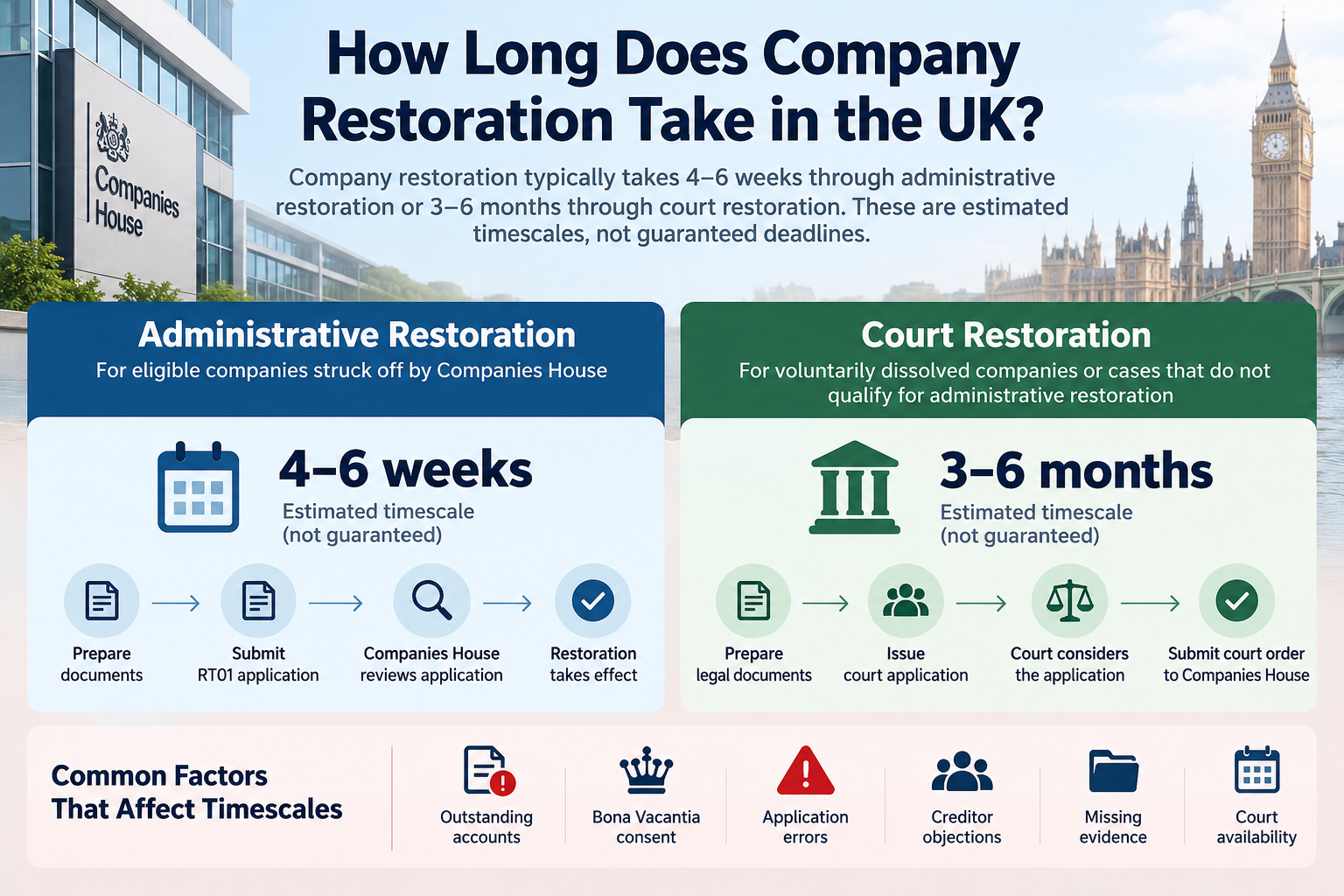
Administrative restoration commonly requires form RT01, overdue statutory filings, applicable penalties, and any required Bona Vacantia consent.The Companies House RT01 application fee is £341 as of November 2026.
Yes. Filing missing accounts can help resolve strike-off proceedings where the accounts contributed to the registrar's concerns. Companies House must still determine whether the outstanding issues have been addressed.
No. Companies House must accept the required filing and formally discontinue the proceedings.
Yes. Directors should take corrective action immediately before dissolution. The applicable deadline depends on the particular statutory procedure.
A creditor with valid grounds and supporting evidence may object after the proposed strike-off has been advertised in The Gazette. Companies House determines how the objection affects the proceedings.
DISS40 records that Companies House has discontinued the current compulsory strike-off proceedings. It does not settle unpaid debts or remove future statutory obligations.
Yes. Suspension is not the same as discontinuance. The proceedings may continue depending on the underlying circumstances and the Registrar's decisions.
Yes, where the company and applicant meet the relevant administrative restoration conditions. Otherwise, court restoration may be necessary.
If your company has received a compulsory strike-off notice, identifying the underlying compliance problem is the first step. Provide the company registration number, the latest Companies House notice, and details of overdue accounts, confirmation statements, or registered office issues.
Company Restoration UK can review the available company information and help identify whether your enquiry concerns outstanding compliance work before dissolution or formal company restoration after dissolution. Any professional service required should be confirmed during the initial assessment.

Specialists at Xact+ Accountants helping UK directors reinstate struck-off companies, meet Companies House and HMRC obligations, and recover frozen funds.
Speak to a restoration specialist today — most eligible companies are back on the register in 4–6 weeks.
Start restorationSend the basics. A case manager checks the register and comes back with the route, the documents and the official costs.
Start with how the company was dissolved.
These answers help estimate work and official costs.
We use these details only to prepare your email summary.
This is an indication from your answers, not a formal assessment.



Leave a comment