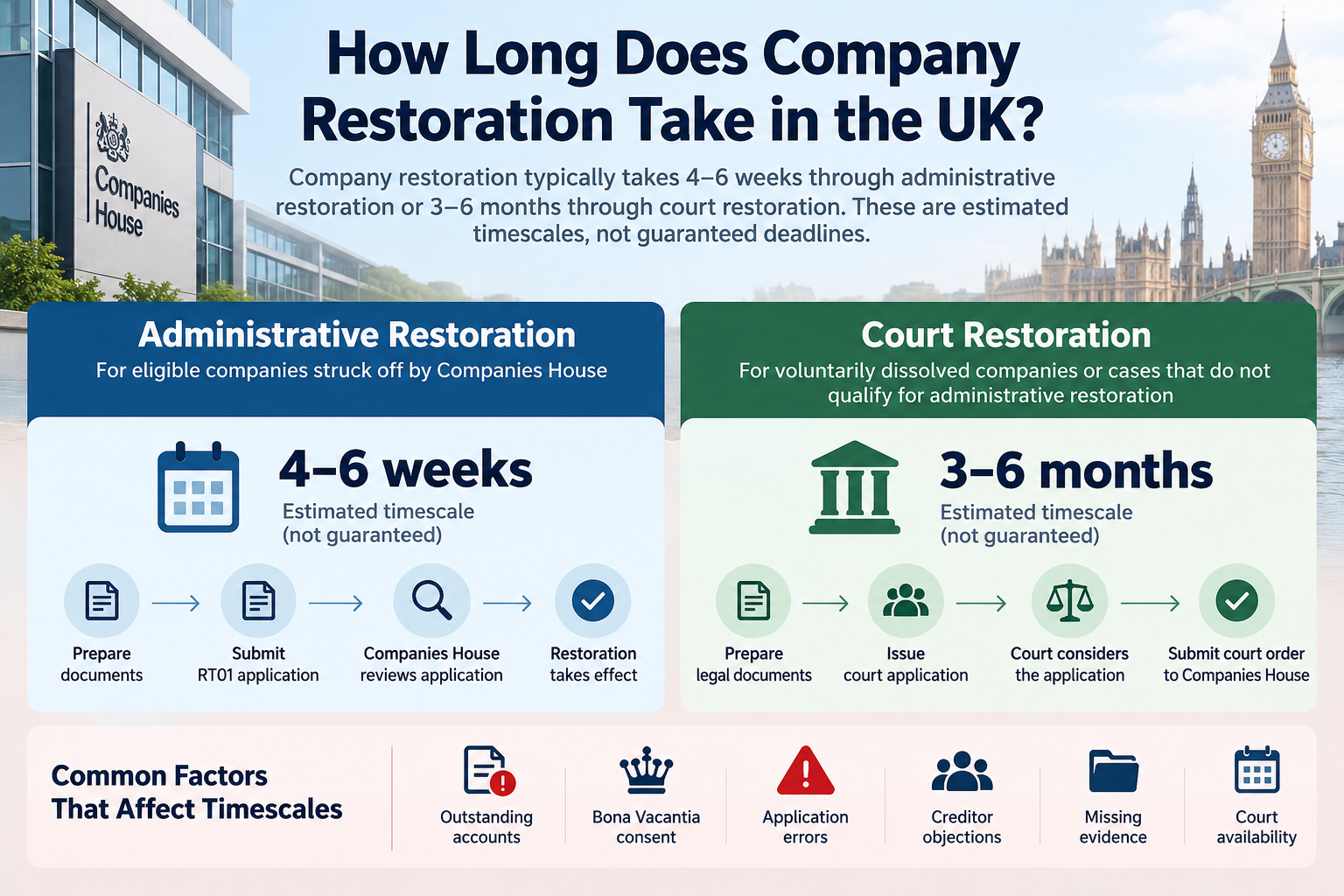
Company restoration in the UK typically takes 4–6 weeks through administrative restoration or 3–6 months through court restoration. These are estimated timescales, not guaranteed deadlines. The process depends on Companies House requirements, outstanding accounts, bona vacante consent, and court availability. This guide explains how long company restoration takes, what causes delays, how RT01 applications work and when banks release funds after restoration.
The restoration route usually has the greatest effect on the timescale. Administrative restoration uses an application to Companies House. Court restoration requires a court order and additional legal steps.
The following table provides a practical comparison.
The administrative and court estimates reflect ranges published by UK restoration service providers. They are not guaranteed by Companies House or the HM Courts and Tribunals Service.For example, an accountant can prepare outstanding accounts while a director gathers supporting documents. However, the company cannot use its restored legal status until restoration takes effect.
Administrative restoration typically takes around 4–6 weeks for straightforward cases, based on indicative professional estimates. Companies House does not guarantee this timeframe. The administrative restoration processing time depends on the company's filing history, outstanding documents and the Registrar's review. Former directors or members can apply through form RT01 when the company meets the statutory eligibility requirements.
Before submitting the application, applicants must address relevant outstanding accounts, confirmation statements, statutory payments, and Crown consent requirements. Companies House examines the application and supporting documents before making its decision.
Missing filings, incorrect payments, or incomplete information may result in rejection. This can extend the overall company restoration timescale. Once the registrar approves the application, restoration takes effect when the registrar sends the decision notice.
The process follows a defined sequence.
Check eligibility: Review the company's dissolution date, strike-off reason and former directors.
Prepare records: Identify outstanding accounts, confirmation statements and unpaid charges.
Obtain consent: Apply to the appropriate Crown representative where required.
Complete RT01: Provide the correct company details and statement of compliance.
Submit documents: Send the restoration package and applicable payment to Companies House.
Await the decision: The Registrar reviews the application and confirms whether restoration succeeds.
Missing forms or payments can delay the Registrar's decision. Missing information may result in rejection and a fresh submission.
Administrative restoration takes effect when the Registrar sends notice confirming the restoration decision.Section 1027 of the Companies Act 2006 establishes this rule.The Registrar records the restoration and publishes the relevant notice in the Gazette.A company is generally treated as having continued in existence as though it had not dissolved.However, restoring its legal status does not automatically reopen a bank account or release its former assets.
Court restoration commonly takes around 3–6 months, based on indicative professional estimates rather than an official deadline. The timescale depends on the court's availability, the evidence required, and whether interested parties object.
Straightforward applications may proceed with limited additional correspondence. Disputed cases may require further witness statements, additional directions or another hearing. After the court approves restoration, the applicant must obtain the sealed court order and deliver it to Companies House. Restoration takes effect when the Registrar receives the required order.
Court restoration is often necessary when:
The company was voluntarily struck off.
A creditor or another interested person applies.
Administrative restoration is unavailable.
The company was dissolved following insolvency proceedings.
A court needs to resolve a legal or procedural issue.
Sections 1029–1032 of the Companies Act 2006 govern restoration by court order.Most ordinary court restoration applications must satisfy a six-year limit. Special exceptions apply, including certain personal injury proceedings.
For companies registered in England and Wales, applicants generally use the Part 8 claim procedure and form N208.The process includes preparing evidence, issuing the claim, notifying relevant parties and obtaining the court's decision.
A solicitor may prepare a witness statement explaining the dissolution and reasons for restoration.The court considers the evidence and decides whether to issue a restoration order.The court may also require payment of relevant costs or compliance with additional directions.For companies registered in Scotland or Northern Ireland, court procedures and documents differ.
Court restoration takes effect when the Registrar receives the required court order.For England and Wales, the applicant must deliver the sealed order to Companies House.For Scottish companies, a court-certified copy is required.The distinction matters when restoration is needed for a contract, legal claim or recovery of assets.Receiving a favourable court decision does not remove the need to complete the registrar stage.
Restoration preparation may take a few days when company records are complete. Missing accounts or financial documents can extend this stage by several weeks.Accountants may need historic bank statements, invoices, and transaction records to prepare overdue accounts. Directors must also check confirmation statements, filing obligations, and outstanding charges.For court restoration, solicitors need time to prepare the claim, supporting evidence, and relevant legal documents. Preparing these records before submission reduces the risk of rejection or requests for additional information.
Administrative applicants should check whether they need:
Form RT01 and the required declaration.
Outstanding accounts from relevant accounting periods.
An overdue confirmation statement.
Evidence supporting eligibility.
Crown consent or a Bona Vacantia waiver.
Payment for statutory fees and existing penalties.
Applicants should distinguish filings outstanding before dissolution from deadlines arising during dissolution. Companies House confirms that certain accounts becoming due while a company was dissolved do not attract late filing penalties. However, penalties relating to overdue accounts before dissolution may still apply.
A company was dissolved after failing to file its annual accounts.The director wants to restart trading but cannot locate the bookkeeping records.The accountant needs bank statements, sales records, and expense details before completing the overdue accounts.These document problems may take longer to resolve than completing RT01 itself.Preparing the financial records first helps avoid delays once the application reaches Companies House.
Company restoration delays usually arise from missing financial records, incomplete applications, unpaid fees or unresolved legal requirements.Outstanding accounts can delay an RT01 application when directors cannot provide the necessary bookkeeping records. Accountants may need to retrieve bank statements, reconcile transactions, or reconstruct previous accounting periods.
Companies House may reject an application if required documents, company details, or payments are missing. This creates additional work before the registrar can reconsider the application.Court restoration follows a different timetable. Creditor objections, additional witness statements, and hearing availability can extend proceedings beyond the initial 3–6-month planning estimate.Bona Vacantia waiver applications may also be delayed if the Treasury Solicitor requires more information or payment of outstanding asset-related costs.Checking the company's filing history and gathering the necessary documents before applying can reduce these avoidable delays.
The following delay factors affect different stages of restoration.
Not necessarily. An accountant can prepare accounts promptly when the records are complete. Missing bank statements and incomplete bookkeeping records can hold up the accounts. An inaccurate set of accounts can create further problems, so speed should not replace proper preparation.
Yes. Companies House can reject an RT01 application that lacks the required information or correct payment.Applicants must supply the appropriate restoration documents and supporting material.Checking the package before posting it reduces the risk of additional correspondence.
The Treasury Solicitor aims to process a qualifying Bona Vacantia waiver application within 20 working days. This target applies to a complete application with the correct payment and no outstanding costs. The standard Treasury Solicitor waiver application charge is £64.A waiver letter confirms the relevant Crown representative's consent to administrative restoration.The Treasury Solicitor will not issue the letter while required information or payments remain outstanding.
No. The correct consent procedure depends on the company's circumstances and jurisdiction. Section 1025 requires written Crown consent where relevant property or rights have vested as bona vacantia. Companies House ordinarily requires a Bona Vacantia waiver letter with an RT01 application. However, the Treasury Solicitor's BVC14 procedure applies to companies meeting specific jurisdiction and asset conditions.
Companies without assets should not automatically assume they must follow the same waiver procedure as companies with assets. The appropriate consent requirements depend on the company's circumstances, any property vested in the Crown, and the relevant Crown representative. Applicants should confirm the applicable consent requirements before submitting their restoration application.
Yes. The published period is a target rather than a guaranteed deadline.An incomplete form, incorrect payment or unpaid asset-related costs can delay the waiver.Where the Crown representative has dealt with company assets, additional costs may also arise.The 20-working-day target is not the entire company restoration timescale. The Registrar must still assess the restoration application.
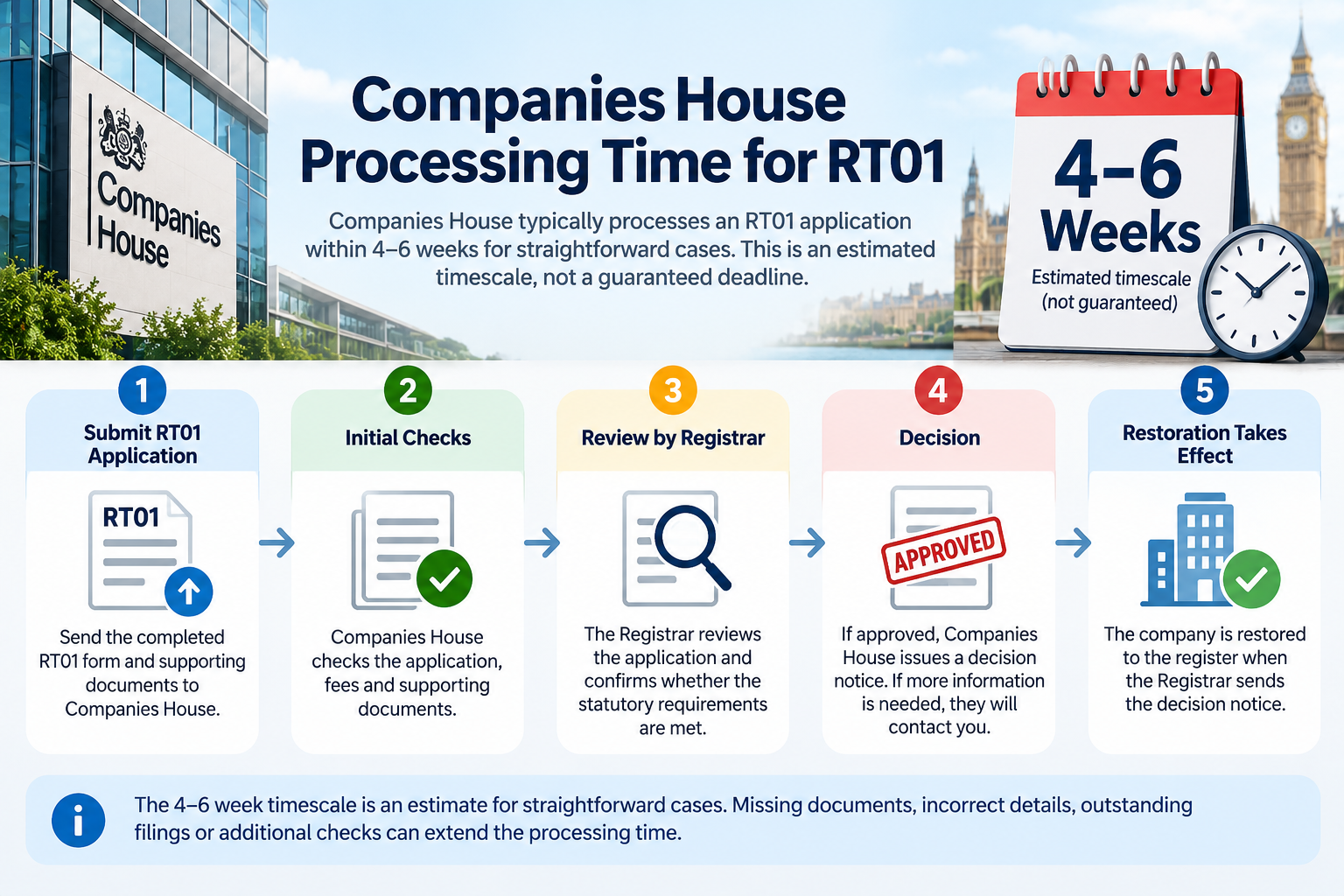
Companies House does not publish a guaranteed RT01 processing time for every administrative restoration application.Form RT01 starts the formal administrative restoration request.The applicant must send the completed form and supporting documents to Companies House.The application currently costs £341, following the fee change on 1 February 2026.
The Registrar examines whether the applicant satisfies the statutory conditions.
The review can involve:
The company's dissolution and strike-off history.
The applicant's eligibility.
Outstanding filings and statutory payments.
Relevant Crown consent.
Supporting evidence where special restoration conditions apply.
Once the Registrar approves restoration, the company returns to the register from the date of the decision notice.
Applicants can monitor the company's public status through the Companies House service.However, the public register does not provide a reliable, live completion estimate for an individual RT01 application.Keep proof of posting and copies of the submitted documents.For restoration enquiries, Companies House directs applicants to its email support rather than telephone assistance.
Court hearing availability, additional witness statements, and unresolved objections can extend the restoration timetable beyond the initial 3–6-month planning estimate. A case may require more evidence, additional directions, or a later hearing date.
Court availability varies by jurisdiction and location.For example, Companies House guidance states that the Registrar of the Companies Court in London usually hears restoration cases on Friday afternoons.
The applicant must give the Registrar at least 10 days' notice of the hearing.These procedural requirements do not guarantee an available hearing date within 10 days.
No. Some restoration applications proceed without substantial opposition.Others involve creditors, disputed property or questions about the company's former activities.A court hearing may take longer when the parties disagree or the evidence is incomplete.Applicants should also allow time for receiving the sealed court order after the decision.Court Restoration Processing Time should therefore include the full process, not just the hearing date.
There is no generally available, guaranteed fast-track restoration service for standard RT01 applications.It may still be possible to restore company quickly by preparing the application correctly and resolving missing documents early.Professional assistance can reduce avoidable mistakes, but it cannot guarantee priority treatment by the Registrar.
Start by confirming that administrative restoration is legally available.Then ask the accountant to prepare all necessary filings together.Check the correct Crown consent procedure before completing the application.Pay the correct statutory charges and review the full package before submission.These steps can reduce delays caused by missing documents.
Urgent court arrangements may be available where circumstances justify them, subject to the relevant court rules and judicial discretion.A solicitor can advise whether the case warrants an urgent application.A commercial deadline alone does not guarantee an expedited court hearing.Avoid providers promising a fixed completion date without explaining the legal and administrative dependencies.
Bank release times depend on whether the funds remain with the bank or have passed to the Crown.Restoration does not guarantee same-day access to money held before dissolution.When a company dissolves, its assets may become bona vacantia.This can include funds transferred from its former bank account.
The restored company should contact the bank and provide evidence of reinstatement.The bank may request identity checks, updated director details and account documents.Processing time depends on the bank's procedures.There is no universal official deadline requiring every bank to reactivate an account or release funds within a fixed period.
An eligible applicant can use form RA15 to seek repayment after restoration.The Bona Vacantia Division publishes a processing period of up to 20 working days after receiving a complete and correct application.The RA15 application itself carries no charge.
Applicants normally need evidence of restoration and details of the receiving bank account. Additional identification documents may also be required.Scottish funds administered by the King's and Lord Treasurer's Remembrancer follow a different process, with separate charges and requirements.
Consider a restored English company whose former bank transferred £15,000 to the Treasury Solicitor. The director obtains restoration confirmation and submits RA15. The application includes bank details and the required identity evidence. Because the amount exceeds £10,000, additional verification requirements apply.
The published 20-working-day RA15 period begins when the department receives the complete application. The company should keep this fund release timeline separate from the time needed to restore its legal status.
Check eligibility and prepare the required documents before applying
Follow this practical checklist:
Check the dissolution record. Confirm the strike-off reason, date and company number.
Choose the correct restoration route. Do not submit RT01 for an ineligible voluntary strike-off case.
Review outstanding filings. Identify accounts and confirmation statements that require attention.
Gather financial records. Retrieve missing statements, invoices and bookkeeping documents.
Confirm Crown consent. Contact the relevant representative where the company has bona vacantia assets.
Check costs and penalties. Separate statutory fees from professional charges and historic liabilities.
Review the application. Check details, declarations, evidence and payments.
Plan asset recovery separately. Contact the relevant bank or Crown representative about releasing funds.
The official Companies House RT01 application fee is £341. An additional £64 charge applies where the standard Treasury Solicitor's Bona Vacantia waiver procedure is required.Together, these charges total £405, but this is not the minimum cost of restoring every dissolved company.The final company restoration cost depends on outstanding filings, existing penalties, Crown consent requirements and any professional assistance needed.
No. £405 covers only the RT01 fee and the standard Treasury Solicitor waiver charge when both apply. A company with overdue accounts may need accounting services before restoration. Existing late filing penalties and other statutory charges may also increase the overall cost.Companies without assets should confirm the appropriate Crown consent requirements rather than automatically assuming the £64 waiver procedure applies.
Court restoration involves different expenses, including court fees and potentially legal representation.The practical next step is to check the company's filing history and restoration eligibility before calculating its total cost. This helps identify which charges actually apply and avoids presenting £405 as a universal minimum.
Preparation may take a few days or several weeks. The time depends on missing filings, accounting records and supporting documents. Companies with complete records can usually prepare their applications more quickly.
Incomplete RT01 applications, outstanding accounts, incorrect payments and missing Crown consent can cause delays. Court restoration may also take longer because of hearing schedules, objections or additional evidence.
The Treasury Solicitor aims to process complete waiver applications within 20 working days. This is an official target, not a guarantee. Other Crown representatives may operate different procedures.
There is no standard guaranteed fast-track RT01 service. Applicants can reduce avoidable delays through accurate preparation. Urgent court proceedings depend on the circumstances and the court's discretion.
There is no standard bank release deadline. Where the Treasury Solicitor holds the funds, a complete RA15 repayment application has a published processing period of up to 20 working days.
No. Companies House does not guarantee a fixed RT01 processing time.Applicants should allow additional time for document checks, missing information and any outstanding statutory requirements.Submitting a complete application can reduce avoidable delays, but it does not guarantee an earlier decision.
Court restoration commonly takes around 3–6 months as an indicative industry estimate. Complex evidence, contested applications and court scheduling may extend the process.
Most ordinary restoration applications have a six-year limit. Certain court applications, including qualifying personal injury matters, have exceptions. Legal advice may help establish whether a particular exception applies.

Specialists at Xact+ Accountants helping UK directors reinstate struck-off companies, meet Companies House and HMRC obligations, and recover frozen funds.
Speak to a restoration specialist today — most eligible companies are back on the register in 4–6 weeks.
Start restorationSend the basics. A case manager checks the register and comes back with the route, the documents and the official costs.
Start with how the company was dissolved.
These answers help estimate work and official costs.
We use these details only to prepare your email summary.
This is an indication from your answers, not a formal assessment.




Leave a comment