A dissolved UK company can usually be restored when it meets the legal conditions for administrative restoration or court restoration. In most cases, you must apply within six years of the date of dissolution. The correct route depends on why the company was dissolved, who wants to restore it and how long ago the dissolution took place. In certain circumstances, a company removed by the Registrar may qualify for administrative restoration. A company that does not meet those conditions may need court restoration instead. A company that was voluntarily struck off can also potentially be restored. However, it would normally need to use the court route rather than administrative restoration. Company restoration is governed mainly by Part 31 of the Companies Act 2006. Administrative restoration is covered by sections 1024 to 1028A, while court restoration is covered by sections 1029 to 1034.
Yes. A dissolved company can often be restored to the Companies House register if the relevant legal requirements are met.
There are two main restoration routes:
Administrative restoration through the Registrar of Companies.
Court restoration through the appropriate court.
Administrative restoration has narrower eligibility requirements. Court restoration covers a wider range of situations. It can be relevant where the company was voluntarily struck off, where administrative restoration is unavailable or where another eligible person, such as a creditor, seeks restoration.
The reason for dissolution, the identity of the applicant, and the date of dissolution normally determine whether restoration is available. Each factor affects the legal route that may be used.
A company can be removed from the register in several circumstances. Companies House may strike a company off where the Registrar believes it is no longer carrying on business or in operation. A company can also be dissolved following a voluntary strike-off application made by its directors. Other cases can involve registration on a false basis, registered office problems or dissolution following formal insolvency proceedings. The reason matters because not every dissolved company can use administrative restoration.
The applicant also affects the route.
Administrative restoration is generally available to a person who was a director or member of the company when it was struck off or dissolved, provided the other conditions are met.Court restoration allows a wider range of potential applicants. These can include former directors, members, creditors, liquidators and people with certain contractual, legal or property interests in the dissolved company.
The normal restoration time limit is six years from the date of dissolution. This applies to administrative restoration and generally applies to court restoration. However, the Companies Act 2006 contains limited exceptions to the six-year court restoration rule.
Administrative restoration may be available where an eligible former director or member wants to restore a company that was removed by the Registrar and the relevant statutory conditions are satisfied. Section 1024 of the Companies Act 2006 deals with applications for administrative restoration. The current legislation allows administrative restoration for qualifying companies struck off under sections 1000 or 1001, and certain companies struck off under section 1002A. Separate provisions also apply to certain registered office rectification cases.
A former director or former member can apply if the relevant conditions are met. A creditor cannot normally use the administrative restoration procedure simply because the dissolved company owes them money. A creditor may instead be able to apply for court restoration. The application must also normally reach the Registrar within six years from the date of dissolution.
For the usual administrative restoration route, the company may qualify where it was struck off under:
section 1000 or 1001 of the Companies Act 2006;
section 1002A in qualifying false-basis registration cases; or
certain registered office rectification provisions.
The exact conditions differ depending on why the Registrar removed the company.
For a company struck off under sections 1000 or 1001, it must have been carrying on business or in operation when it was struck off. This requirement should not be applied as a blanket rule to every administrative restoration case. For example, different statutory conditions apply to certain companies struck off under section 1002A and registered office rectification provisions. This distinction matters because simply saying that every company “must have been trading” can be misleading.
Court restoration may be required where administrative restoration is unavailable, or the circumstances fall within the court restoration provisions. Section 1029 of the Companies Act 2006 governs applications to the court for restoration. Court restoration can cover companies removed through several statutory routes. It can also apply in certain cases where a company was dissolved following formal insolvency proceedings.
A court application may therefore be relevant where:
the company was voluntarily struck off;
the applicant is a creditor or another qualifying interested person;
administrative restoration conditions are not met;
the company was dissolved following certain insolvency proceedings; or
the circumstances otherwise fall within the court restoration rules.
Court restoration is available to a wider group of potential applicants than administrative restoration. Administrative restoration is generally available to eligible former directors and shareholders. People with a recognised legal interest in a dissolved company may also apply to the court to have it restored.
Depending on the circumstances, these can include:
Companies House also refers to pension fund managers or trustees and other people who appear to the court to have an interest in the matter. Eligibility should therefore be considered based on the applicant's relationship with the dissolved company.
A company can usually be restored within six years of its formal dissolution date. The time limit does not start when a director finds out that the company has been dissolved.An application for administrative restoration must normally be made within six years. Section 1030 of the Companies Act 2006 sets a general six-year limit for court restoration, although specific exceptions apply.
Usually not, but limited exceptions can allow a court restoration application after the normal six-year period. The six-year rule should therefore not be described as absolute.
Section 1030 allows a restoration application to be made at any time for certain proceedings involving damages for personal injury. Separate limitation rules for the underlying proceedings can still apply.
Another exception can apply where:
The company was struck off under a qualifying Registrar strike-off provision
an administrative restoration application under section 1024 was made within the permitted period; and
The Registrar refused that application.
In these circumstances, an application to the court can be made within 28 days from the issue of the Registrar's refusal notice, even if the normal six-year period has expired. These are limited statutory exceptions. They do not create a general right to restore any company after six years.
Yes, different types of dissolved companies may be capable of restoration, but the available route can change according to the circumstances.
Yes, potentially. A company whose directors voluntarily struck it off would normally need to be restored through the court. Administrative restoration is not normally available where the directors themselves applied for voluntary strike-off. If the directors used form DS01 to close the company, they would normally need to apply to the court to restore it. The RT01 administrative restoration route would not usually apply.
Yes. A company struck off by the Registrar may qualify for administrative restoration if it meets the legal requirements. For a company struck off under section 1000 or 1001 of the Companies Act 2006, the applicant must generally be a former director or member. The company must also have been trading or in operation when it was struck off, and the application must normally be made within six years. Other administrative restoration requirements must also be met. If the company does not qualify for administrative restoration, restoration through the court may still be possible.
A dormant company may still be restored after dissolution, but its circumstances determine the route. Administrative restoration usually requires a company struck off under section 1000 or 1001 to have been carrying on business or in operation when it was struck off. A dormant company may not meet that condition. Restoration through the court may still be possible. Check why the company was struck off and what it was doing at the time before choosing a route.
The reason for restoring the company may matter, especially in a court application. However, a practical reason alone does not mean the company qualifies for restoration.
Common reasons for restoration include:
recovering money held in a company bank account;
recovering property;
dealing with an outstanding contract;
pursuing or defending a legal claim;
recovering funds held by Wise, Stripe, PayPal or another payment provider;
dealing with company intellectual property; or
continuing the company's previous business.
The company and the person applying must still meet the requirements for their chosen restoration route.
When a company is dissolved, its property and rights may pass to the Crown as bona vacantia. This can include money in a bank account, property, and other company assets.If assets have passed as bona vacantia, an administrative restoration application may require a waiver letter from the relevant authority. For more detail, see our guide to bona vacantia and recovering frozen company funds.
Yes, it may have to pay penalties for accounts that were already overdue before dissolution.Companies House normally disregards the time the company spent dissolved when calculating how late those accounts are.Accounts that became due while the company was dissolved are treated differently. Companies House says no late filing penalty applies if those accounts are delivered on restoration. Check each accounts deadline before preparing the restoration application
Once eligibility is established, the next step is to identify the correct restoration route and any outstanding requirements.An eligible administrative restoration case normally proceeds through an RT01 application. Court restoration follows a separate court procedure. The detailed filing requirements, court procedure, fees and document preparation should be considered separately from the initial question of whether the company can be restored. For the full process, see our guide on how to restore a struck-off company.
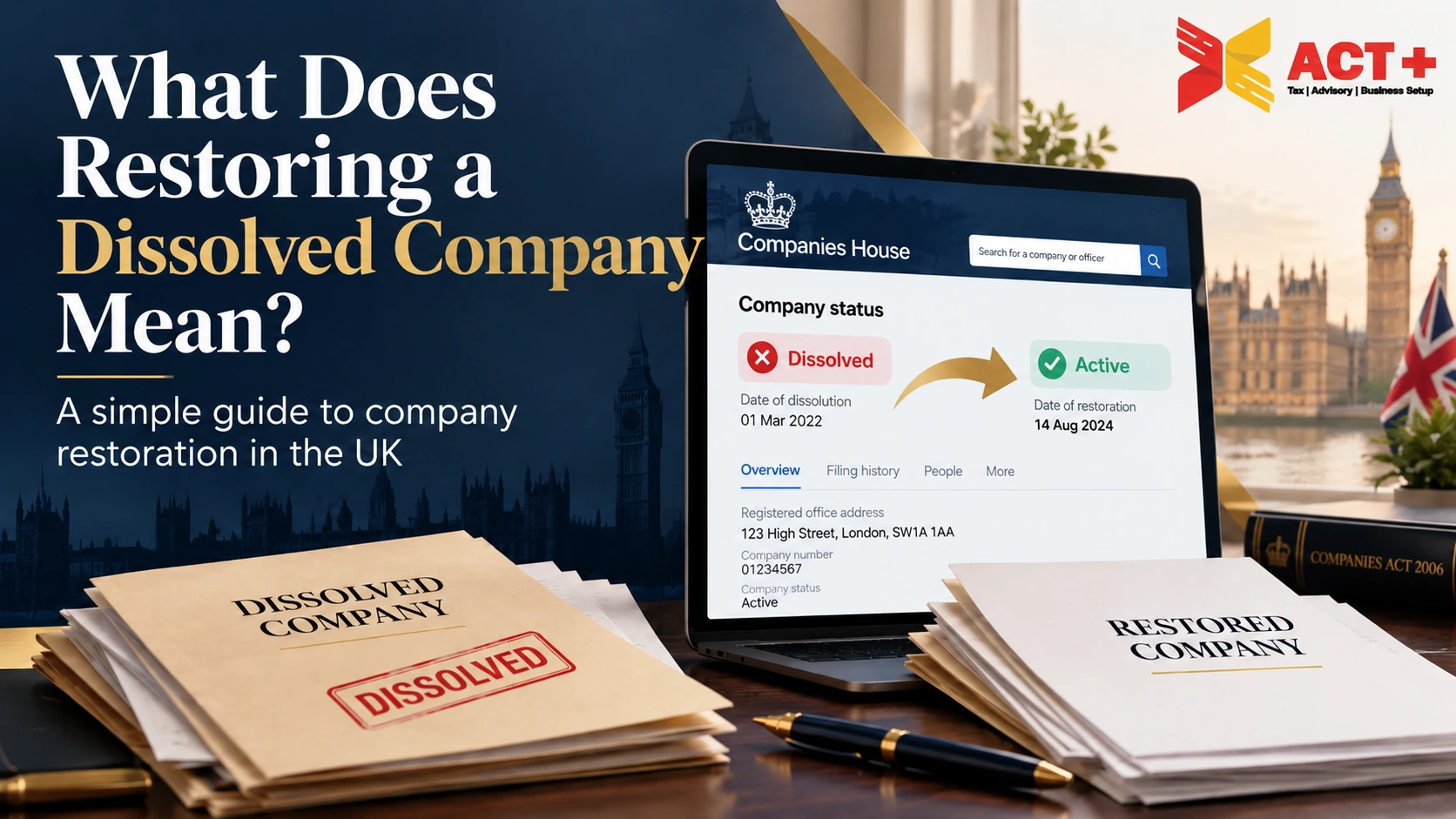
A restored company is generally treated as having continued in existence as if it had not been struck off and dissolved. Restoration returns the company to the register, but it does not necessarily remove every outstanding compliance issue. Accounts, confirmation statements, tax records, banking arrangements, and other matters may still need attention. Companies House also confirms that the court can make further directions intended to place the company and affected persons in the position they would have been in if dissolution had not occurred.
No. Restoration depends on how the company was dissolved, who is applying, when the dissolution occurred, and whether the legal requirements for administrative or court restoration are met.
The normal time limit is six years from the date of dissolution. Limited exceptions apply to certain court restoration applications.
Yes, potentially. A former director may qualify for administrative or court restoration depending on how the company was dissolved and whether the relevant conditions are satisfied.
Yes, potentially. A former member can apply for administrative restoration where the applicable conditions are met and may also qualify to seek court restoration.
A creditor may apply to the court for restoration. Creditors are among the categories identified by Companies House as possible court applicants.
Not in every restoration case. For the usual administrative restoration of a company struck off under sections 1000 or 1001, the company must have been carrying on business or in operation when it was struck off. Other restoration routes and circumstances have different conditions.

Specialists at Xact+ Accountants helping UK directors reinstate struck-off companies, meet Companies House and HMRC obligations, and recover frozen funds.
Speak to a restoration specialist today — most eligible companies are back on the register in 4–6 weeks.
Start restorationSend the basics. A case manager checks the register and comes back with the route, the documents and the official costs.
Start with how the company was dissolved.
These answers help estimate work and official costs.
We use these details only to prepare your email summary.
This is an indication from your answers, not a formal assessment.



Leave a comment