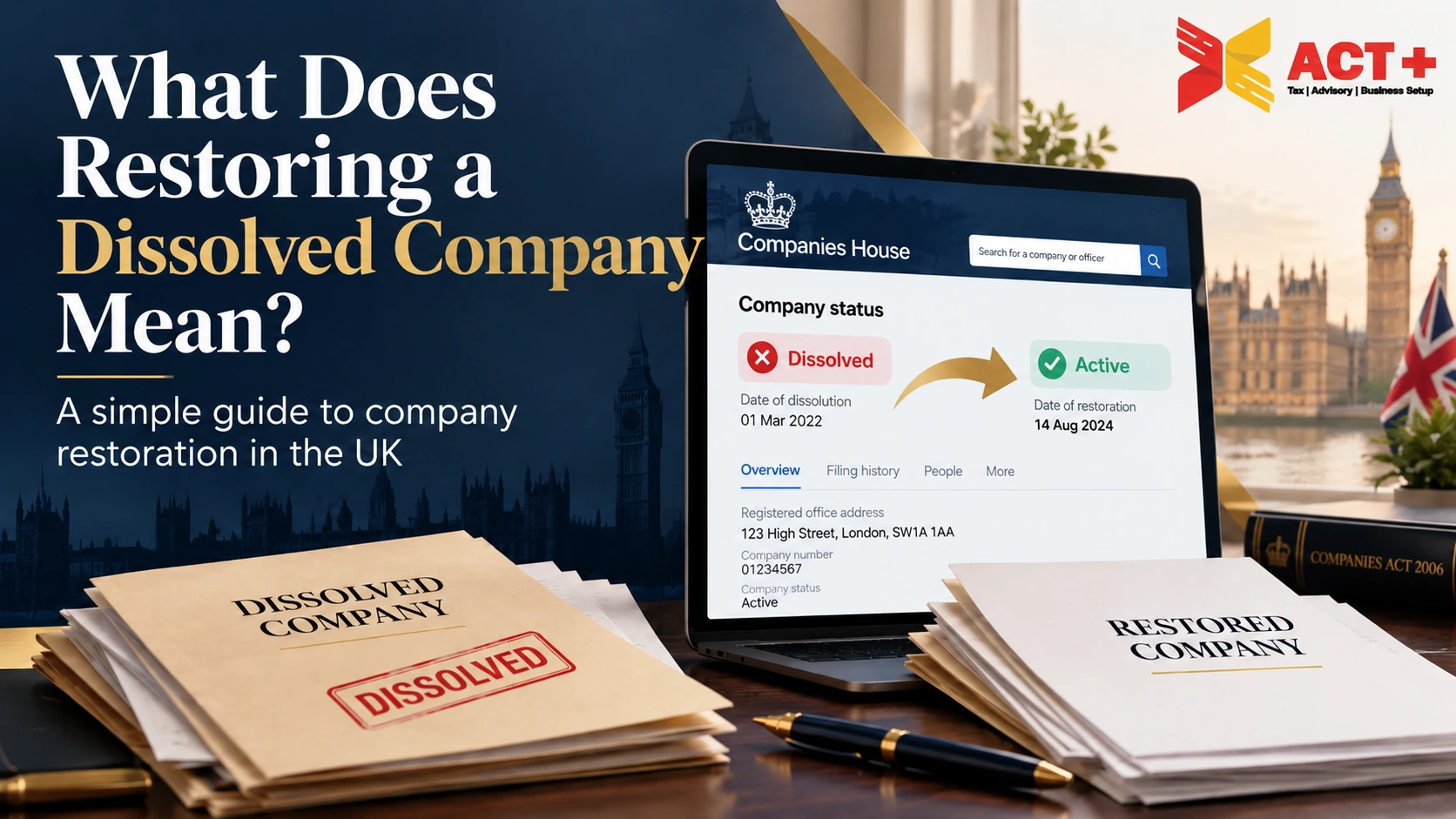
Restoring a dissolved company means returning an existing company to the Companies House register so it legally exists again. The process restores the company’s legal status rather than creating a new business. The restored company normally keeps its registered company number, corporate history, and existing identity. UK company law generally treats it as having continued in existence despite the period of dissolution. Company restoration may be necessary to recover assets, access frozen funds, continue business activities, or deal with legal matters. The correct restoration route depends on how Companies House removed the company from the register.
A dissolved company stops existing as a legal entity, and Companies House removes it from the active register. Dissolution may follow a voluntary strike-off or action taken by the Registrar of Companies. The reason for dissolution becomes important if someone later wants to restore the business. The company can no longer carry on normal business activities after dissolution. Its directors no longer control an active legal company.
A company bank account will normally become frozen once the bank becomes aware of the dissolution. The account can no longer receive normal payments. Money remaining in the account can pass to the Crown. Other company assets can also be affected. These assets can include land, property, cash, shares, trademarks, patents, and other intellectual property. Certain legal rights belonging to the company can also pass to the Crown. This property is generally known as Bona Vacantia, meaning ownerless property. Section 1012 of the Companies Act 2006 governs this position for dissolved companies.
Former directors and shareholders cannot simply treat these assets as their personal property after dissolution. For example, a former director cannot withdraw company money merely because they previously controlled the business. Restoration may be needed before the company can recover or deal with its property.The detailed rules differ by jurisdiction and asset type. These issues belong within a dedicated Bona Vacantia explained guide.
Company restoration returns the dissolved company to the Companies House register and restores its corporate existence. It reverses the effect of dissolution rather than forming another company. The Companies Act 2006 generally treats a restored company as having continued in existence. This principle applies to both administrative and court restoration. That legal continuity has several practical effects. The company returns to the register under its existing corporate record. Its earlier accounts, confirmation statements, and officer history remain connected with that record. The restored company can also deal with property that remains available to it. This can include cash, land, shares, or intellectual property. Previous rights and obligations can also become relevant again. Restoration does not wipe away the company’s earlier corporate history.
Outstanding filing matters may still require attention. These can include outstanding accounts, confirmation statements, and filing fees and penalties that were due before the company was dissolved. The exact requirements depend on the restoration route and the company’s history. Restoration does not automatically reactivate every commercial account. A bank may request evidence of restoration before restoring account access. A payment processor may carry out its own verification checks. The company may also need to update its HMRC position if it resumes trading. This distinction is important. Legal restoration brings the company back into existence, while third-party systems may require separate action.
Yes. A restored company generally remains the same legal entity that existed before dissolution. Companies House does not normally create another business when restoring the company. The restoration notice identifies the existing company and its registered company number. The company's earlier Companies House record also remains in place. This means the company does not start a completely new corporate history from the restoration date. Its previous filings remain associated with it. Its historic directors, shareholders and filing events also remain part of the public record. The legal principle goes further than simply reopening the Companies House record. For administrative restoration, the company is treated as having continued in existence despite the dissolution period. Court restoration has the same general effect.
However, this legal continuity does not mean every practical event automatically reverses. A court can make further directions where necessary. These directions can help place affected parties closer to their position before dissolution. The company name can also create an exception. Companies House normally restores the company under its previous name. However, another company may have registered that name during the dissolution period. In that situation, the restored company may need another permitted name. Companies House can also temporarily restore it using its registered number as its name. A change of name does not create another legal entity. The restored business remains connected with the same corporate record and registered company number.
No. Company restoration revives an existing company, while incorporation creates a new legal entity.
This distinction affects corporate history, company numbers, assets and previous obligations.
| Point | Restored company | Newly incorporated company |
|---|---|---|
| Legal identity | Existing company continues | A new legal entity begins |
| Company number | Existing number remains | Companies House issues a new number |
| Corporate history | Existing history continues | A new history starts |
| Previous filings | Remain linked to the company | Start from incorporation |
| Existing assets | May return to the restored company | Do not automatically transfer |
| Historical obligations | Can remain relevant | Do not automatically transfer |
| Main purpose | Reinstates an existing company | Creates a new company |
Registering another company with a similar name does not restore the original business. For example, assume ABC Trading Ltd was dissolved while holding £20,000 in a bank account.The former director cannot create ABC Trading UK Ltd and claim the original company's £20,000. The new company would have a separate registered number and separate legal identity. The money belonged to the dissolved company. Restoration may therefore be required to recover those funds. The same principle can apply to land, intellectual property, contractual rights and money owed by customers. Company formation and company restoration solve different legal problems. Incorporation creates a company for future activity. Restoration brings an existing dissolved company back onto the register.
There are two main ways to restore a dissolved company: administrative restoration and court restoration. The correct route depends mainly on how the company was dissolved and who wants to restore it. Administrative restoration involves applying directly to the Registrar of Companies. Court restoration requires an application to the appropriate court. The court can order Companies House to restore the company. A person cannot simply choose whichever route appears easier. Administrative restoration has specific statutory conditions. Companies that do not meet those conditions may require court restoration. The Companies House record usually provides the starting point. It can show the dissolution date, strike-off history and relevant filing events. These details help determine whether administrative restoration or court restoration is the appropriate route.
Administrative restoration allows certain former directors or members to apply directly to Companies House without obtaining a court order first. It usually applies where the Registrar removed the company from the register, and the statutory conditions are satisfied. Companies House confirms that a former director or member can apply in qualifying cases. For the usual Registrar strike-off route, the company must have been trading or operating when it was removed. Applications are normally available within six years of dissolution.
The application uses Form RT01. The applicant may also need to bring the company's Companies House record up to date. This can involve filing outstanding accounts or confirmation statements. Relevant fees, penalties and supporting documents may also be required. A Bona Vacantia waiver can become necessary where company property or rights passed to the Crown. Administrative restoration does not normally apply where the directors voluntarily struck the company off. Companies House states that these cases require court restoration instead. The detailed eligibility tests, RT01 requirements and document process belong on a dedicated Administrative Restoration page.
Court restoration uses a court order to return a dissolved company to the Companies House register.This route becomes relevant where administrative restoration is unavailable or unsuitable.A company dissolved through voluntary strike-off commonly requires court restoration.Court restoration can also be available to a wider range of interested parties.Possible applicants include former directors, members, creditors and liquidators. Certain people with contractual, legal or property interests may also apply.For example, a creditor may need restoration to pursue money owed by the dissolved company.A former shareholder may need restoration to recover company property.Someone with an existing legal claim may also need the company restored before progressing that claim.
In England and Wales, Form N208 can be used when applying for a court order to restore a company. Procedures differ in Scotland and Northern Ireland. Once the court grants restoration, the required court order must reach the Registrar. Companies House can then restore the company to the register. The detailed court procedure, evidence and filing requirements belong on a separate Court Restoration page.
Someone may need to restore a dissolved company when it still has money, property, rights or unresolved legal matters. Frozen company funds are a common reason. A bank may hold money that belonged to the company before dissolution. Payment processors and online marketplaces may also hold company balances. Those providers may require evidence that the company exists again before releasing funds.
Property can create another reason for restoration.A dissolved company may remain connected with land, a commercial property or another property interest. Dissolution can then prevent a normal sale, transfer or refinancing. Intellectual property can create similar difficulties. The dissolved company may own a trade mark, patent, registered design or another commercial right. Qualifying assets generally pass to the Crown when the company dissolves. Restoration may therefore provide a route for the company to regain control of those assets.Some companies also need restoration after an unexpected strike-off.
For example, missed filing obligations can lead to Registrar action. The former directors may later want to continue using the same company.Legal proceedings provide another common reason.A creditor may want to pursue an unpaid debt. A shareholder may need to deal with company property.Someone with a contractual relationship may also have an unresolved claim involving the company.
Companies House recognises several categories of interested parties within the court restoration rules.Another situation involves money owed to the dissolved company.Suppose a customer owed the company £15,000 before dissolution. Creating a new company would not automatically transfer that debt. The original company owned the legal right to collect it.Restoration can therefore become important where the original corporate identity matters. The reason for restoration influences the route and supporting documents.Recovering frozen money can involve different practical steps from dealing with land or court proceedings.
Company assets can return to the restored company because restoration generally reverses the legal effect of dissolution. During dissolution, qualifying company property normally becomes Bona Vacantia. This can include cash, land, shares, intellectual property and other rights owned by the company. Restoration changes that legal position. Government Legal Department guidance explains that Bona Vacantia normally ends once the company returns to the register. Property that remains available can then belong to the company again.
However, restoration does not guarantee the return of every original asset. The Crown may have sold or otherwise disposed of an asset while the company remained dissolved. Section 1034 of the Companies Act 2006 protects a disposal made during that period. The restored company cannot simply reverse that completed transaction. Instead, different rules can apply to the consideration or value received for the asset.This distinction can matter for valuable land, shares and intellectual property. Cash held by the Bona Vacantia Division can also require a separate repayment application.Current Government Legal Department guidance provides the RA15 process for relevant cash assets after restoration in England and Wales.
Different Crown representatives deal with assets in Scotland, Northern Ireland and certain other jurisdictions. Restoration also does not automatically reopen a former bank account. The restored company may need to provide Companies House evidence before the bank releases funds or restores access. This creates an important distinction between recovering legal ownership and obtaining practical access to an asset. Restoring a dissolved company therefore brings the original company back onto the Companies House register. It does not create a replacement business.The company normally keeps its corporate identity, registered number and historical record. Restoration can also help recover assets, access funds and resolve unfinished company matters.The available route depends on the reason for dissolution and the circumstances of the applicant. Understanding those points is the first step before starting a dissolved company restoration.

Specialists at Xact+ Accountants helping UK directors reinstate struck-off companies, meet Companies House and HMRC obligations, and recover frozen funds.
Speak to a restoration specialist today — most eligible companies are back on the register in 4–6 weeks.
Start restorationSend the basics. A case manager checks the register and comes back with the route, the documents and the official costs.
Start with how the company was dissolved.
These answers help estimate work and official costs.
We use these details only to prepare your email summary.
This is an indication from your answers, not a formal assessment.



Leave a comment