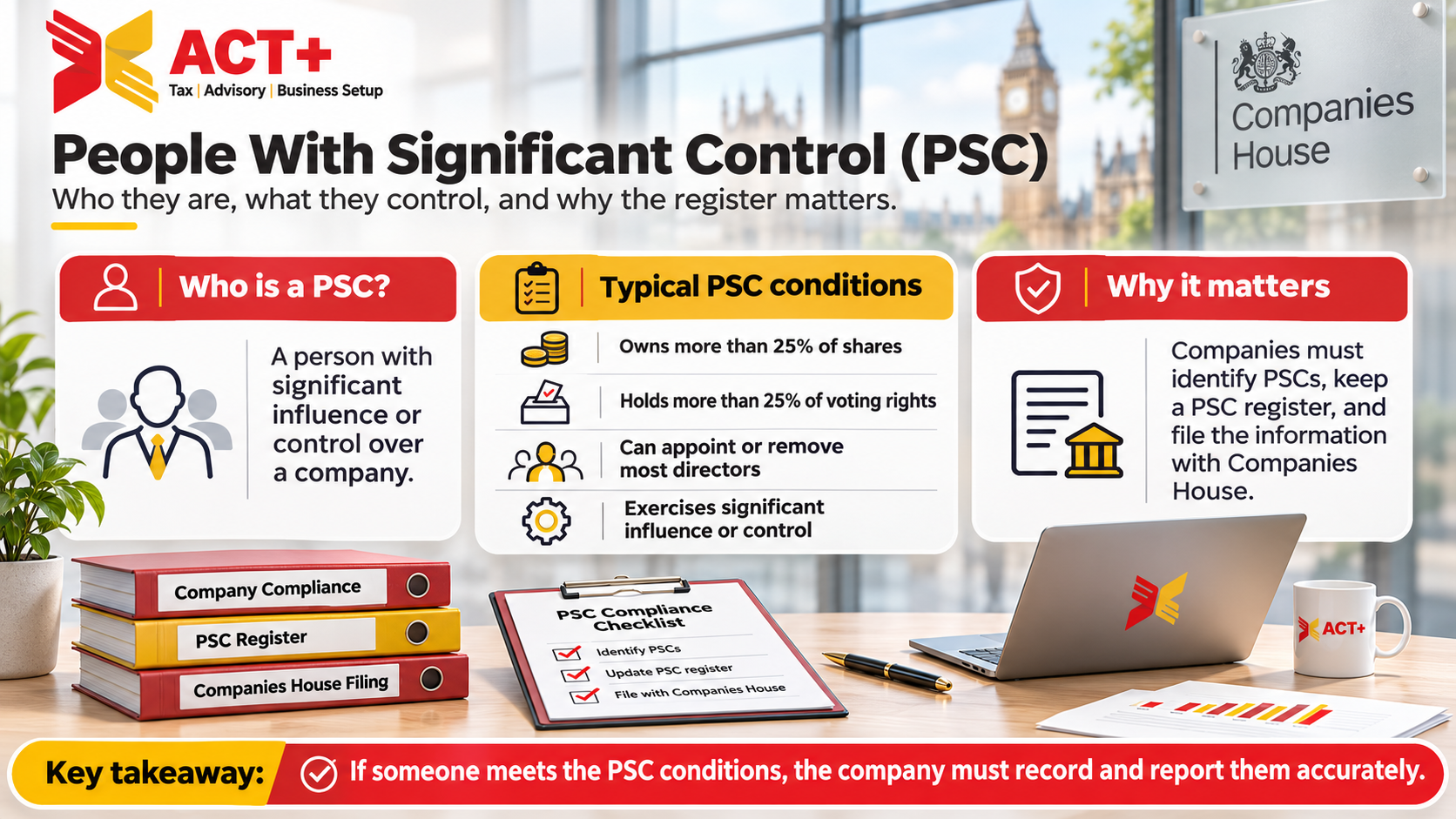
People with significant control meet statutory tests for company control. A person who meets a test may qualify as a PSC. UK companies must identify their PSCs. They must report the relevant details to Companies House. The company reports who controls it and how. Individual PSCs must verify their identity and provide their personal code. These duties have separate deadlines. The company may need to report a controller before confirming their details.
A person with significant control meets a statutory company control condition. Control can come from shares, votes or board appointment rights. It can also come from significant influence. A company can have several PSCs. Companies House calls the applicable conditions the nature of control.
Consider a company with two shareholders. Each holds 50% of the shares. Both meet the share ownership condition. Check their voting rights separately. The company may need to report both conditions for each person.
Schedule 1A of the Companies Act 2006 sets five control conditions. The first two use a threshold of more than 25%. Exactly 25% falls below that threshold. Another condition can still make someone a PSC.
The fourth condition covers rights and influence over company decisions. Review agreements and how the company makes decisions in practice. Companies can omit the fourth condition when an earlier condition applies. This exception covers the first three conditions in the table.
The fifth condition covers certain trusts and firms without legal personality. Their trustees or members must satisfy a relevant company control condition. The test considers who can influence or control their activities. Consult the statutory guidance for these arrangements.
Which ownership bands should you report?
Report share ownership and voting rights in their applicable bands. One person can fall into different bands. For example, 30% ownership and 60% voting rights fall into different bands. Use the person’s actual rights to select each band.
A shareholder owns shares. A PSC meets a statutory control condition. A shareholder can hold both roles. Someone without shares can qualify through board appointment rights. Check voting rights and control arrangements alongside the share register.
Start with the register of members and articles of association. Check each share class and the rights attached to it. Review shareholder agreements for voting or board appointment rights. Trace indirect control through any corporate shareholders.
List each shareholder and their shareholding.
Calculate voting rights separately.
Identify who can appoint or remove most directors.
Review arrangements that give someone significant influence.
Trace any corporate ownership chains.
Confirm who qualifies and gather their required details.
The first relevant legal entity in the ownership chain is registrable. Companies House uses RLE for a relevant legal entity. Suppose a UK parent company owns all the subsidiary’s shares. If the parent qualifies as an RLE, report the parent. Use PSC02 to report that entity.
Send a formal notice when you need information from someone. You can also contact people who may know the relevant details. Keep copies of your inquiries and responses. Check the unconfirmed PSC deadline while you gather evidence.
Report initial PSC details when you incorporate the company. Use the relevant Companies House filing for later updates. The reporting duty depends on what the company knows. Record the date the company first knows about the controller. Record when the company confirms their status and particulars.
The company can face a reporting deadline before enquiries finish. If the unconfirmed duty applies, file the relevant PSC statement. Continue your enquiries and report the confirmed particulars when available. Use the separate PSC filing promptly. Review the public record after Companies House processes the update.
What details do you need for an individual PSC?
Confirm the individual’s particulars, dates and nature of control. Check the details against the information you obtained during your enquiries. Record the date the company confirmed the details.
Companies House keeps the usual residential address off the public register. The service address usually appears publicly. Check the disclosure rules if the PSC has applied for protection.
Companies House maintains PSC information on its register. The local PSC register requirement ended on 18 November 2025. Companies still maintain their register of members. Keep evidence supporting each PSC decision and filing.
File the appropriate statement if your investigation identifies no PSC. Use the relevant investigation statement while enquiries remain open. Choose the statement that reflects what the company knows. Use PSC08 to report a statement. Use PSC09 to update a previously filed statement.
Use PSC01 to report a new individual PSC after incorporation. Use PSC02 for a registrable relevant legal entity. Record when the new controller gained significant control. Confirm their required particulars and reportable conditions. Check the reporting deadline using the company’s confirmation date.
Suppose a shareholder’s holding increases from 20% to 30%. Their new holding meets the share ownership condition. Check whether their voting rights also exceed 25%. Report the date the increase took effect. Check whether the same transaction changed anyone else’s control.
Use PSC04 to report changes to an individual PSC’s details. Use PSC05 to report changes to a relevant legal entity. Changes can include a new service address or ownership band. Record the effective date and when you confirmed the change. Use the reporting deadline that applies to the confirmed change.
Suppose a PSC increases their shareholding from 40% to 60%. Their share ownership moves into the second band. Their voting rights may stay in the original band. Update the shareholding band and retain the correct voting band.
Use PSC07 when a controller ceases to meet every qualifying condition. Enter the date they stopped qualifying. Check whether someone else gained control through the same transaction. Report the incoming controller separately if they qualify. File the relevant statement if nobody qualifies after your review.
A share sale can leave someone’s board appointment rights intact. Check those rights before reporting the cessation. If the person still qualifies, update their nature of control.If a PSC dies, keep their entry pending the relevant grant. Companies House specifies a grant of probate or letters of administration. Companies House requires no identity verification for a deceased PSC. Check how the estate affects control before making further updates.
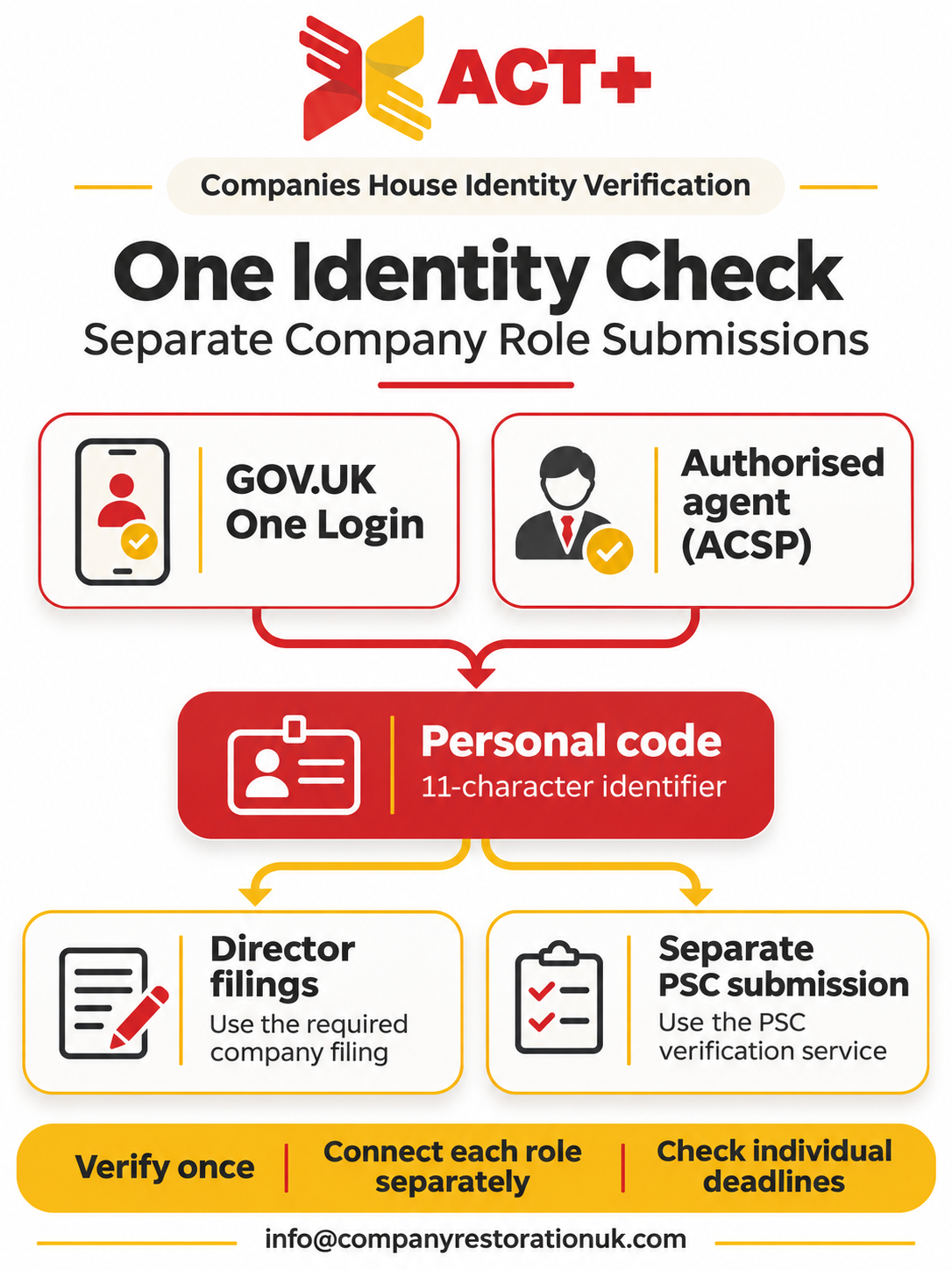
Individual PSCs must verify their identity for Companies House. The requirements began on 18 November 2025. Individuals can use GOV.UK One Login or an authorised agent. Companies House issues a personal code after successful verification. The PSC must provide the code and identity verification statement.
Check the Companies House register for the PSC’s exact dates. Use the confirmation statement date to calculate the relevant window. Filing the statement early leaves that window unchanged.
Someone who holds both roles uses the same personal code. They must provide it separately for each role. The director uses the company’s confirmation statement. The PSC uses the dedicated verification service. Request any extension before the applicable deadline passes.
Correct a PSC filing through the procedure for the original document. Use a change notice when the facts changed after filing. Use the applicable correction procedure when the original filing contained errors. An incorrect birth date can prevent Companies House from matching verification details.
Respond to a formal PSC information notice within one calendar month. Failing to respond or giving false information can constitute an offence. Keep copies of notices, replies and supporting records.
Compare registered PSC details with the company’s ownership records. Identify when each difference arose. Check outstanding confirmation statements and any separate PSC filings. Confirm the filing sequence with Companies House for your restoration case.
Frequently Asked Questions
A PSC meets a statutory condition for company control. The person may qualify through share ownership or voting rights. Board appointment rights and significant influence can also qualify. A company can report several PSCs.
Yes, another control condition can make them a PSC. Exactly 25% falls below the share ownership threshold. Check voting rights, board appointment powers and significant influence. Report the conditions that apply under Companies House rules.
Start with the register of members and articles of association. Check shareholdings, voting rights and board appointment powers. Trace ownership through corporate shareholders. Identify the first qualifying RLE in each relevant ownership chain.
Use PSC01 to report a new individual PSC after incorporation. Confirm their details, start date and nature of control. Use PSC02 for a registrable relevant legal entity. Check the separate reporting duty if confirmation remains outstanding.
Yes, the individual uses one personal code for both roles. They must submit it separately for each role. The director uses the company’s confirmation statement. The PSC uses the dedicated verification service.
Follow the procedure for the original Companies House filing. For an IN01 error, post RP01 and the relevant IN01 section. Include evidence of the correct birth date. For a later PSC01 error, replace the filing through WebFiling.
Speak to a restoration specialist today — most eligible companies are back on the register in 4–6 weeks.
Start restorationSend the basics. A case manager checks the register and comes back with the route, the documents and the official costs.
Start with how the company was dissolved.
These answers help estimate work and official costs.
We use these details only to review your case and reply to you.
When you press Send My Details for a Free Review, your answers and contact details are sent to the Xact+ restoration team for a free case review. Read the privacy policy.
This is an indication from your answers, not a formal assessment.



Leave a comment