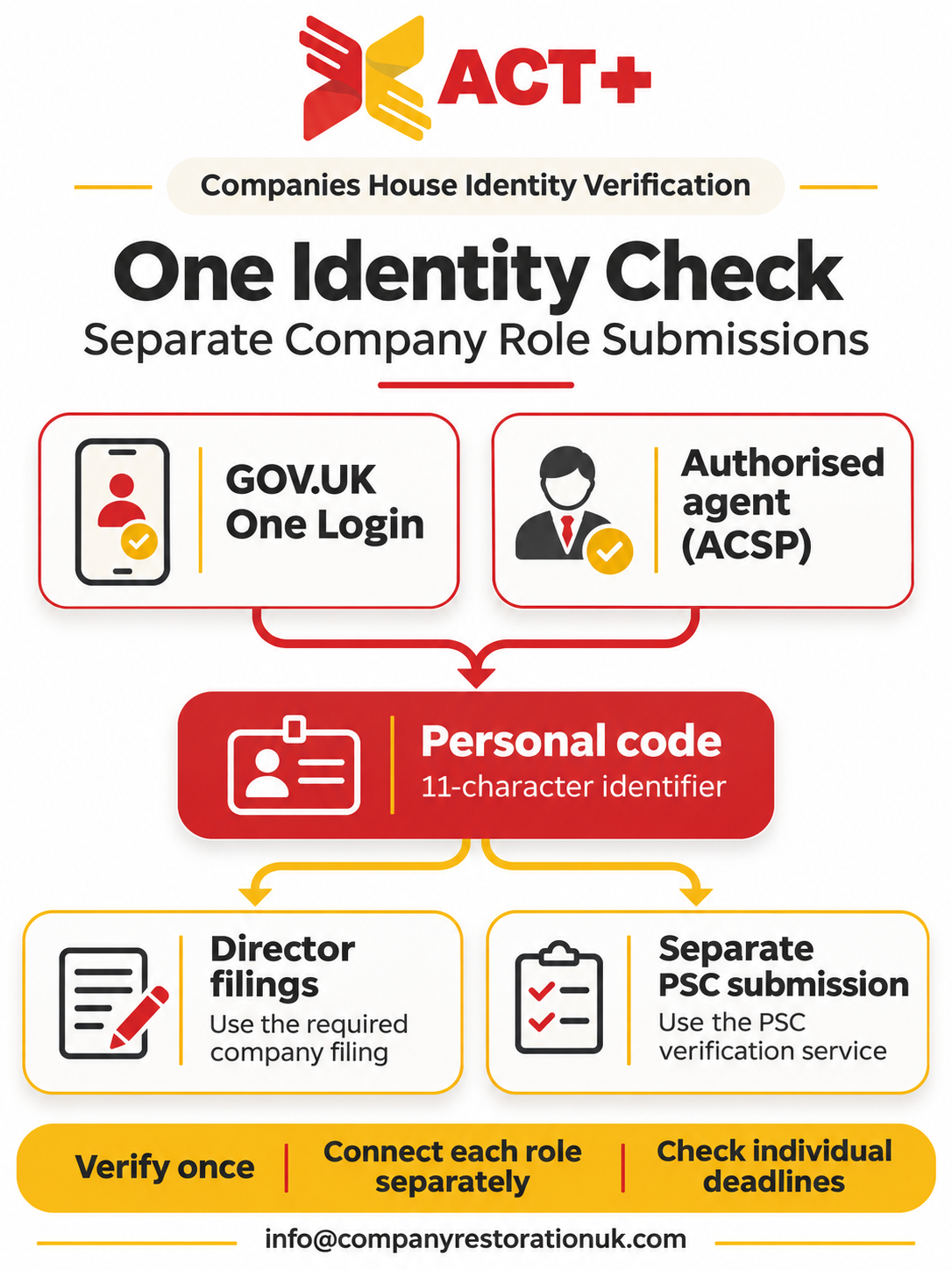
Companies House identity verification checks the identities behind company roles. Directors and individual people with significant control must meet verification requirements. You can verify through GOV.UK One Login or an authorised agent. After verification, Companies House issues your personal code. You then use that code to connect each company role.
Mandatory requirements began on 18 November 2025. Existing directors and PSCs entered a twelve-month transition. Each person's role and circumstances determine their deadline. Check your own dates before arranging company filings.
Restoration applicants also need the correct paper confirmation statements. Identity checks do not replace those filings. This guide explains verification routes, deadlines, documents and personal codes. It also covers restoration-specific checks and practical examples.
Companies House identity verification involves checking identity and linking company roles. Completing the first stage does not complete every filing obligation. The personal code connects the two stages.
An accountant may handle role submissions after you complete verification. Agree those responsibilities before starting. Otherwise, you could hold a code without completing required submissions.
Directors and individual PSCs must verify under current requirements. Equivalent roles include members, general partners and managing officers.
Directors of overseas companies with UK registrations must also verify. Applicants registering as Companies House authorised agents must verify too.
A PSC means a person with significant control. Common conditions include holding more than 25% of company shares. Holding more than 25% of voting rights also commonly qualifies. Rights to appoint or remove a director majority can also qualify.
Significant influence or control can create PSC status too.
Share ownership alone does not automatically create verification duties. Check whether the shareholder also holds a qualifying role. Likewise, company secretaries may separately act as directors or PSCs.
Companies House plans later requirements for general filers and corporate directors. Corporate LLP members and officers of corporate PSCs also await implementation. Check current guidance before applying those future requirements.
Your role and appointment history determine your verification deadline. The transition began on 18 November 2025. That date did not create one deadline for everybody.
Check your recorded PSC window through the official service. Filing a confirmation statement early leaves that window unchanged. These windows concern the initial role-linking requirement. They do not create annual identity checks.
Existing directors provide verification details with their next required confirmation statement. Directors must address each company appointment separately. New directors supply details through their appointment or incorporation filing.
Companies with overdue statements need particular attention. Transitional legislation includes specific provisions for overdue filings. Do not assume delayed filing extends your permission to act. An overdue filing can affect when director-activity restrictions begin.
Ask your adviser to check the transitional rules for your company.
PSCs submit through the official PSC verification-details service. A director who also acts as PSC completes both submissions. The same personal code supports both roles.
The service allows requests for a fourteen-day extension. Request that extension before your verification deadline passes. Do not assume an extension automatically covers other filing deadlines.
Start with One Login or a registered authorized agent. Plan Companies House identity verification around your documents and location.
Identify your director and PSC roles.
Check the deadline for each role.
Select your verification route.
Prepare the required identity documents.
Complete the identity check.
Retrieve your personal code.
Provide director details through the required company filing.
Submit any separate PSC verification details.
Start through the official identity verification service. Answer questions about yourself during the identity check. Your company number does not replace personal identity evidence.
The online service accepts these photo identification categories:
Biometric passports from any country.
UK photo driving licences, including provisional licences.
UK biometric residence permits, or BRPs.
UK biometric residence cards, or BRCs.
UK Frontier Worker permits, or FWPs.
Prepare your current address and the year you moved there. Use your own email address for One Login. The app does not accept expired passports. The app accepts DVLA licenses expiring within the last ninety days.It accepts BRPs, BRCs, and FWPs that expire within eighteen months.The bank details and post office routes exclude expired documents.
One Login assesses which alternative routes you can use. UK residents may qualify for security questions or post office checks. Start online before visiting a participating post office. Follow the instructions for your available route.
Do not post identity documents with your restoration application. Use the official verification process or your chosen authorized agent. Companies House directs applicants away from emailing or posting identification.
Overseas directors can use eligible GOV.UK routes or an authorised agent. Their overseas address does not remove verification responsibilities. A biometric passport from another country can support online checks.
Overseas directors should check documents before choosing a verification route. Then confirm whether the selected route supports those documents. Avoid paying for professional checks before understanding your free options.
If you lack suitable online documents, approach an ACSP. Ask which alternative evidence the provider accepts. Do not assume every provider supports every document or country.
An overseas individual can direct a UK limited company. An overseas company can separately maintain a registered UK establishment. For overseas companies, official guidance uses the establishment's registration anniversary. Identify the entity type before applying that timing.
An ACSP verifies identities as a Companies House-authorised agent. ACSP means Authorised Corporate Service Provider. The provider must register with Companies House. A UK anti-money-laundering supervisory body must also supervise the provider.
Ask your accountant whether they hold ACSP registration. Ordinary accountancy services do not establish authorized-agent status. Use the provider list linked from official verification guidance.
Before ordering ACSP identity verification, confirm the service scope.
Ask whether the agent only checks your identity. Separately confirm who handles director and PSC submissions.
Ask for the fee, accepted documents, and expected turnaround. Request a secure document-upload method. Avoid sending sensitive identification through an unfamiliar messaging account.
GOV.UK One Login provides identity verification free of charge. ACSPs may charge for their professional services. There is no single standard ACSP fee. Check whether the quotation includes VAT and role submissions. Keep those charges separate from restoration and accounting work. A paid identity check does not settle outstanding company obligations.
A Companies House personal code identifies you after successful verification. Companies House issues an eleven-character code to the individual. It does not belong to a particular company.
Companies House identity verification normally requires one successful identity check. Use the resulting code across your relevant company roles. Do not repeat verification unless Companies House instructs you.
Open “Manage account” in your Companies House account. Sign in with the email address from your verification. Companies House also emails codes after eligible One Login checks. That email arrangement covers verification after 8 July 2026.
Following ACSP checks, Companies House emails the address your agent supplied. Contact the agent if that address contains an error. Save your code to your account for future access. Follow the personal code instructions for the relevant route.
Check the code and date of birth before retrying. Incorrect register details can prevent successful identity linking. Your agent may also need to correct verification details.
Contact Companies House if someone compromises your code. Companies House can issue a replacement and cancel the previous code. Keep codes outside public documents and general team trackers.
Use your code for director appointments, incorporations and required identity submissions. Existing directors connect their identities through the confirmation statement process. PSCs use their separate verification-details service.
The personal code identifies the person behind a company role. The company authentication code provides access for company filings. Check which code the filing service requests before entering details.
Share your personal code only with trusted filing representatives. You can authorise an accountant to provide details for you. Retain access to your own account and verification correspondence.
Companies House requires verified directors before accepting the company's confirmation statement. The filing includes director codes and the required verification statement. Previously supplied director verification details need not accompany every later CS01.
Review current directors before preparing the statement. Confirm which directors have already linked their verified identities. Address outstanding checks before arranging the submission.
Restoration applicants must submit paper form CS01. Use the confirmation date due before the company’s strike-off. Contact Companies House if the historical date remains unclear. Companies House identity verification also affects the director information accompanying CS01. Use Part 6 for outstanding current-director verification details. Omit information only where you have already supplied it. Part 6 does not collect PSC or corporate-director verification details. Download the current CS01 form and additional pages. Keep the historical confirmation date while following current filing instructions. A historical date does not automatically remove verification requirements.
For restoration preparation, ask your adviser to check:
The company number and historical confirmation date.
Current directors and outstanding identity links.
Required CS01 additional pages.
Separate PSC submissions and deadlines.
Any Companies House instructions specific to the case.
These are practical preparation checks, rather than a complete restoration checklist. Explore our company restoration services for a case review.
One personal code can support several companies and multiple roles. Each directorship or PSC role still needs its identity connection.
Consider Aisha, a hypothetical director and PSC of two companies. She completes Companies House identity verification once. Companies House then gives her one personal code.
Both companies still need their required director verification submissions. Aisha also needs separate PSC submissions for both companies. Her single identity check therefore supports four company-role connections.

Specialists at Xact+ Accountants helping UK directors reinstate struck-off companies, meet Companies House and HMRC obligations, and recover frozen funds.
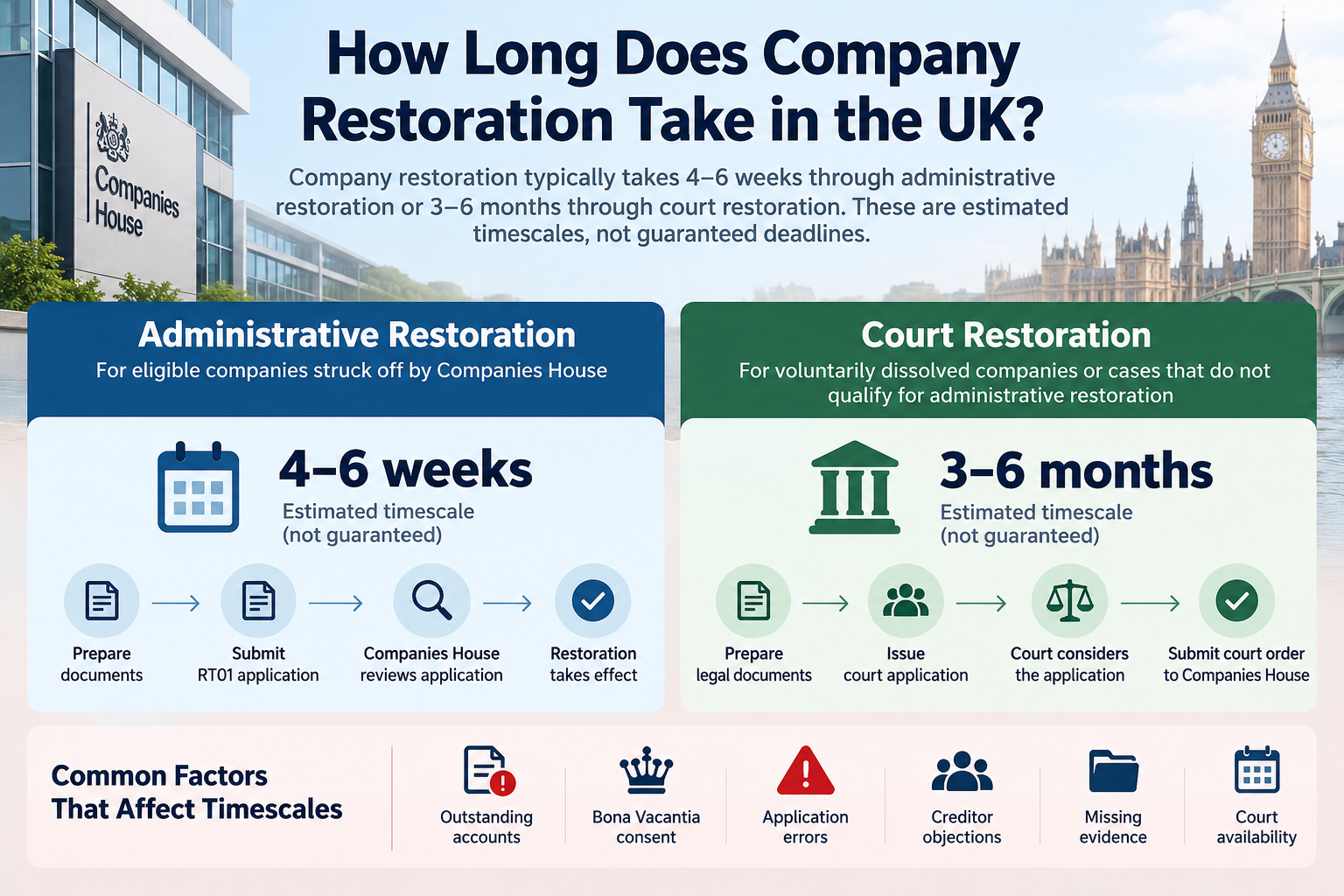
Speak to a restoration specialist today — most eligible companies are back on the register in 4–6 weeks.
Start restorationSend the basics. A case manager checks the register and comes back with the route, the documents and the official costs.
Start with how the company was dissolved.
These answers help estimate work and official costs.
We use these details only to prepare your email summary.
This is an indication from your answers, not a formal assessment.



Leave a comment