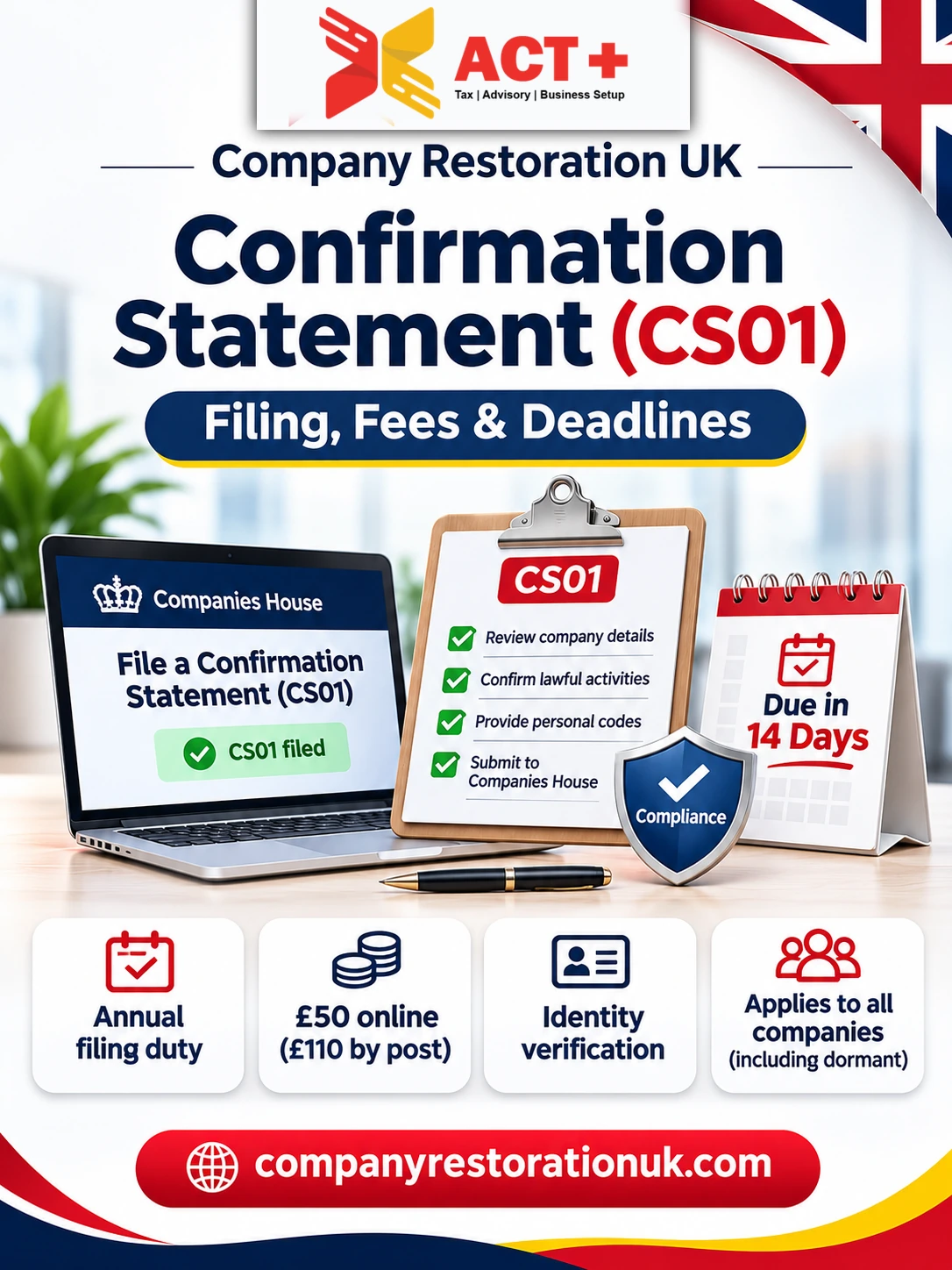
A confirmation statement confirms company information held by Companies House. Every UK company must file one at least annually. This includes dormant and non-trading companies. Directors must check the register before submitting form CS01. They must also confirm the company's intended lawful activities. Companies House requires identity verification for current directors. This guide covers deadlines, fees, filing methods, and overdue statements. It also explains the CS01 requirements during company restoration.
CS01 confirms specified information on the Companies House register. It replaced the former annual return, known as AR01. The Companies Act 2006 sets the filing requirement. The statement covers relevant ownership, activities, and company-register information. It does not replace annual accounts or corporation tax returns.
Yes. Dormant companies must still file their confirmation statements. They must file even when no company information changes. Dormant accounts do not replace this separate filing duty.
Companies must file CS01 within 14 days after their review period. The first review period begins on incorporation. Subsequent periods follow the preceding confirmation statement date. The normal review period lasts twelve months. Companies House displays the actual due date online.
This example follows a company's first incorporation anniversary. Check your company's actual record before relying on any date.
Yes. Directors may submit a confirmation statement early. They select a new confirmation statement date. The next review period begins the following day. Early filing can change future review dates. It cannot reset the annual fee payment period. Update your filing calendar after submitting an early statement.
Companies House charges £50 digitally and £110 by post. These government fees apply from 1 February 2026. An accountant may charge additional professional fees.
The company pays once during each twelve-month payment period. Further submissions during that period require no second annual fee.
The review period controls the company's filing deadline. The payment period controls when Companies House charges its annual fee.
Illustrative example: This company's payment period runs January through December.
Your company's payment period may follow different dates. For newer companies, it starts on the incorporation date. Older companies may follow their former annual-return anniversary. Early CS01 filing does not change those payment dates.
Directors must review the register and correct inaccurate company information. Some changes require separate forms before CS01 submission.
SIC codes describe the company's main business activities. CS01 can update relevant SIC classifications. Shareholder information identifies the company's members and relevant holdings. CS01 can update prescribed shareholder information. A share transfer requires separate legal steps. Share allotments can also require separate Companies House filings. A statement of capital records relevant issued share details. Directors should compare CS01 details with the company's records.
People with significant control (PSCs) meet qualifying ownership or control conditions. Someone holding over 25% of shares may qualify. Other statutory control conditions can also apply. Report PSC changes through the appropriate separate service. Check each PSC's identity verification obligations as well.
Companies must maintain a registered email address. Companies House uses it for official correspondence. The public register does not display this address. Provide a missing email address through the appropriate CS01 section. Change an existing address using the separate online service. Keep the company's authentication code available for that change.
CS01 requires directors to confirm the company's intended lawful activities. Companies House requires this declaration even for dormant companies. Directors must complete it before submitting the statement. An incomplete statutory declaration may prevent filing acceptance.
Current directors must verify their identity and provide personal codes. Companies House introduced mandatory verification requirements on 18 November 2025.A verified person receives a unique Companies House personal code. That individual can reuse the code for multiple appointments.
These codes are separate. Do not share directors' personal codes unnecessarily.
A person may hold both roles within one company. For example, a director may own 60% of its shares. That person verifies their identity once. Companies House issues one personal code. The person reports the code separately for each role.
An existing director-PSC has a separate 14-day PSC submission period. It begins the day after the company's confirmation statement date. Filing CS01 early does not change this PSC deadline.For example, the confirmation statement date may be 31 March. The separate PSC period then runs 1–14 April. Check the register for your actual verification dates. A PSC without a directorship may follow different deadlines. Newly appointed PSCs can also have different submission periods.
Choose the Companies House service that accepts your company structure. The simplified service has narrower eligibility than WebFiling.
Your company must meet every condition below:
It is a private company limited by shares.
It has exactly one shareholder.
It has between one and five officers.
It has no more than five PSCs.
Companies House already holds every director's personal code.
The simplified service cannot update company information. Other companies must use WebFiling or another permitted route. For example, two shareholders make a company ineligible. The company should use WebFiling instead.
You can submit an online confirmation statement through the appropriate Companies House filing service. Before starting, check your filing deadline, review the company’s details, and gather the codes needed to sign in and complete the submission. File any changes separately where required, then follow these steps to submit your statement and check that Companies House has accepted it for filing.
Check your company's review date and filing deadline.
Review every relevant company detail.
Submit any changes requiring separate filings.
Complete directors' identity verification requirements.
Gather the required personal codes.
Locate the company's authentication code.
Choose the correct Companies House filing service.
Complete the applicable CS01 sections.
Confirm the company's intended lawful activities.
Submit the statement and pay any annual fee due.
Check Companies House acceptance in the filing history.
A submission acknowledgement does not guarantee acceptance. Review any rejection or correction request promptly.
Yes. Companies House accepts the official paper confirmation statement. The paper's annual fee is £110. Use the current form and required continuation pages. Paper submissions normally take longer than digital filing.
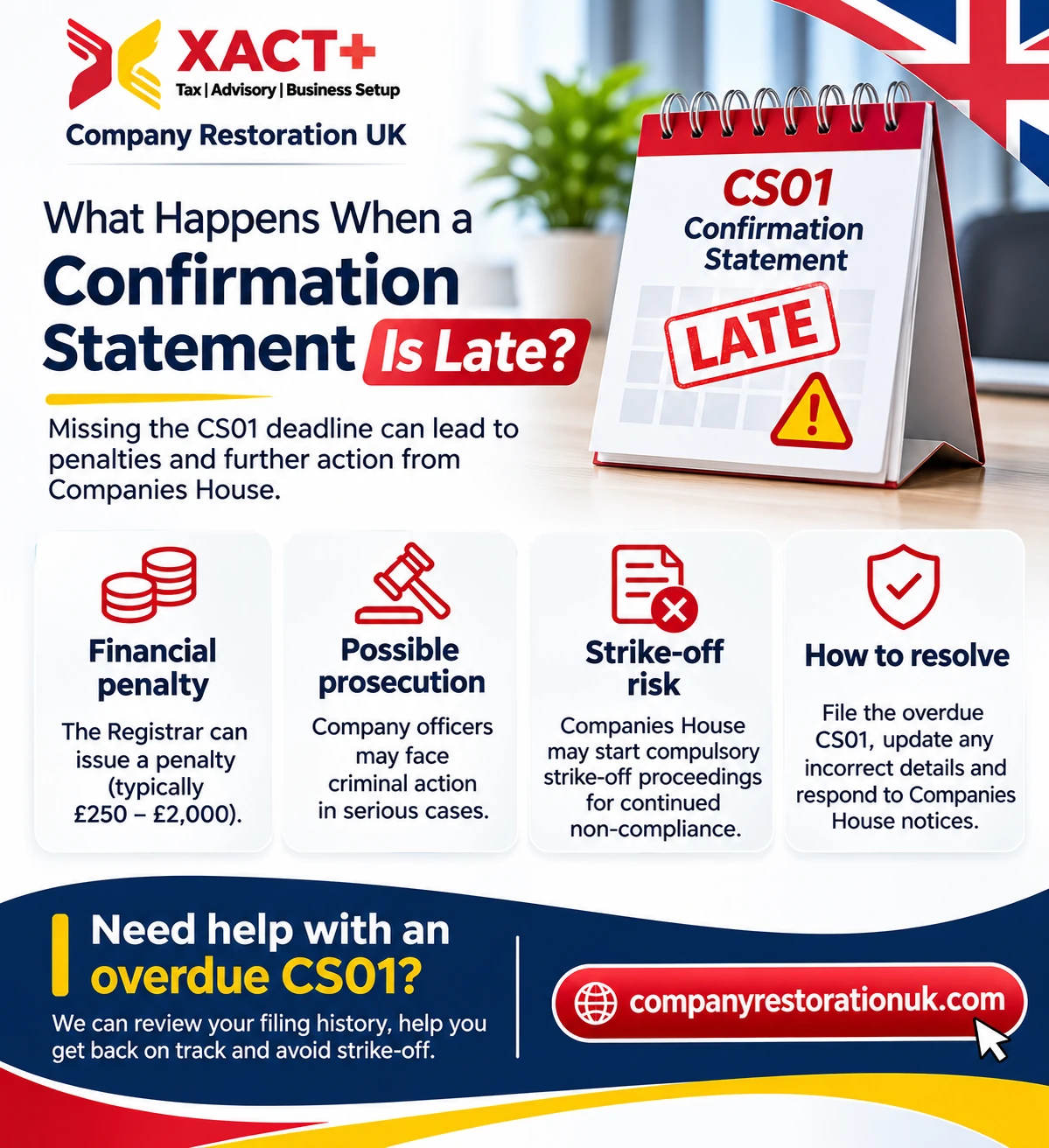
Late CS01 filings can trigger financial penalties and other enforcement. Companies House may also begin compulsory strike-off proceedings.
The Registrar may impose a financial penalty for relevant offenses. This operates separately from prosecution in a criminal court. A warning notice generally precedes a financial penalty. The notice allows written representations within the specified period. That period must provide at least 28 days. Timely compliance can prevent a penalty under the published process. Further penalties may follow continued non-compliance.
Companies House publishes this indicative fixed-penalty scale:
These amounts are not automatic CS01 late-filing bands. The offence, circumstances, and repeat history determine the outcome. Daily-rate penalties may also apply. Company officers can also face criminal prosecution for filing offences. The applicable court fines depend on the jurisdiction and legislation. Do not assume one £5,000 cap applies across every jurisdiction. Annual accounts have a separate late-filing penalty regime.
Check the overdue period and company filing history. Update any inaccurate details using the correct services. Complete outstanding director verification requirements. Submit CS01 and check the registrar's response. Review any penalties and strike-off correspondence separately. Filing CS01 does not automatically discontinue strike-off. Companies House must decide whether the underlying concerns are resolved.
Administrative restoration requires paper CS01 forms for outstanding confirmation statements. Companies House requires the relevant historic confirmation dates. Use the confirmation date due before strike-off. Check earlier filings to identify the correct date. Contact Companies House if the date remains uncertain. Paper CS01 alone does not restore a dissolved company. The restoration route has separate eligibility and filing requirements.
Yes. Companies House allows companies to file CS01 early. Early filing starts a new review period. The next review period begins the following day. However, the annual payment period remains unchanged.
Companies House will not accept CS01 without the required director verification. The director must verify their identity first. They must then provide their Companies House personal code. The company can submit CS01 once all directors meet these requirements.
Yes. An authorised accountant can prepare and submit CS01. They must use an appropriate Companies House filing service. Directors remain legally responsible for accurate information and timely filing.
The correction process depends on the incorrect information. Directors must use the appropriate Companies House filing procedure. Officer, registered office, and PSC changes require separate updates. Contact Companies House if you need to correct an accepted CS01.
No. Filing CS01 does not automatically stop compulsory strike-off. Companies House must review the company's outstanding compliance issues. The registrar decides whether to discontinue the proceedings. Check the filing history for a DISS40 discontinuance notice.
Use the historical confirmation date Companies House requires for restoration. Check the company's previous CS01 filings and review periods. Administrative restoration requires paper confirmation statements for outstanding periods. Contact Companies House if the correct historical date remains unclear.
Company Restoration UK reviews outstanding filings in restoration enquiries. Dissolved companies may need overdue statements and annual accounts. Provide your company number and relevant Companies House correspondence. The team can review available filing history and required documents. Standalone CS01 filing assistance requires confirmation during your enquiry. Companies House decides filing acceptance and restoration outcomes.

Specialists at Xact+ Accountants helping UK directors reinstate struck-off companies, meet Companies House and HMRC obligations, and recover frozen funds.
Speak to a restoration specialist today — most eligible companies are back on the register in 4–6 weeks.
Start restorationSend the basics. A case manager checks the register and comes back with the route, the documents and the official costs.
Start with how the company was dissolved.
These answers help estimate work and official costs.
We use these details only to prepare your email summary.
This is an indication from your answers, not a formal assessment.



Leave a comment