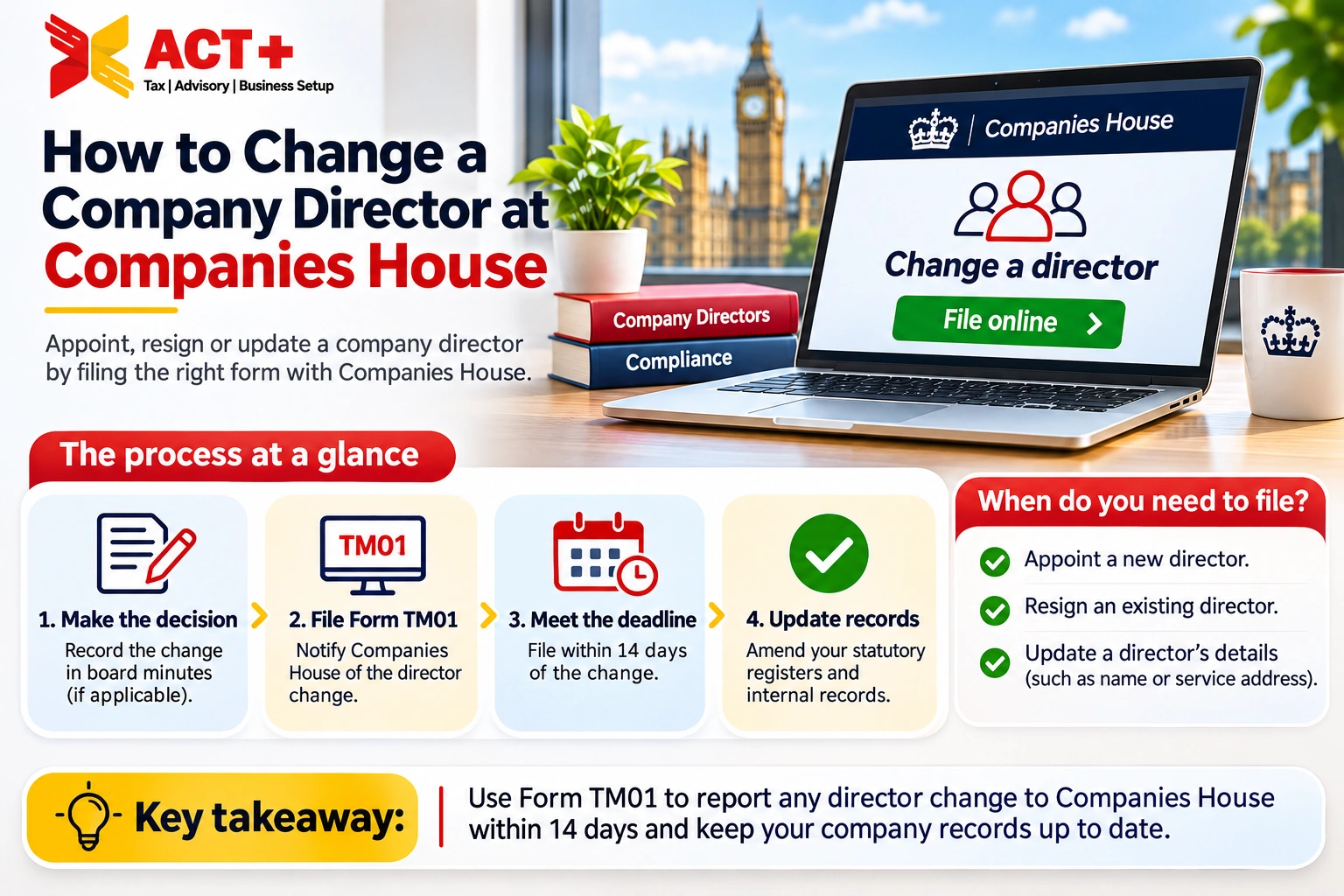
To change company director details, file CH01 with Companies House. Use AP01 to appoint an individual director. Use TM01 when a director resigns, dies, or otherwise leaves office. If you replace a director, file both TM01 and AP01. Report each change within 14 days of its effective date.
Check your company’s articles for appointment approvals and resignation procedures. Get the incoming director’s consent and include their Companies House personal code in AP01. For statutory removal, shareholders must pass an ordinary resolution at a meeting. If an earlier filing contained an error, follow the Companies House correction procedure.
Section 167G of the Companies Act 2006 covers appointments and cessations. Section 167H covers changes to required director information. Historic errors follow the relevant correction route. Companies House charges nothing for routine online director changes. An adviser may charge for preparing or submitting the paperwork. Save the filing acknowledgement and check if Companies House accepts it.
Approve the appointment under the company’s articles, then file AP01. The model articles allow a board decision or ordinary resolution. Check your own articles before choosing either route. Obtain the person’s consent and check their eligibility. A private company needs at least one director. At least one director must be an individual. An individual director must be at least 16. Check for disqualification or restrictions arising from bankruptcy.
Record the decision. Keep the board minutes or shareholder resolution. Note the date the appointment takes effect.
Confirm identity verification. Ask for the incoming director’s Companies House personal code. Use it to connect their verified identity to the appointment.
Collect the required details. Confirm their name, date of birth and nationality. Collect their service address and usual residential address.
Submit the appointment. Use the online service or the current paper form. Check the filing history after Companies House accepts it.
Example. Priya joins the board on 3 November. Sam resigns on 5 November. Enter 3 November on Priya’s AP01. Enter 5 November on Sam’s TM01. Use each event’s effective date, even when filing both together.
Give the company a resignation notice under its articles. State the date you intend to leave office. Keep a copy and ask the company to acknowledge receipt. Under the model articles, resignation follows the notice’s terms. The company then reports the departure on TM01.
If you are the only director, discuss succession early. The company must still meet its minimum director requirement. Agree who will handle filings and records after you leave. Check your employment terms if you also work there. Review any notice requirements in your director’s service agreement.
Shareholders can remove a director by ordinary resolution at a meeting. Section 168 of the Companies Act 2006 provides this route. Shareholders must give special notice of the proposed resolution. They cannot use a written resolution for section 168 removal. Check the articles for any other valid removal route.
Give special notice. Give the company at least 28 days’ notice before the meeting. Section 312(4) allows an exception when the company calls the meeting afterwards. The meeting must fall within 28 days of that notice.
Send the director a copy. The company must do this promptly. Section 169 gives the director the right to speak. It also gives them rights concerning written representations.
Hold the meeting. Check shareholders’ voting rights before the vote. Record the outcome and confirm the effective removal date.
Report the departure. The company files TM01 after the appointment ends. Keep the special notice and meeting records.
Review the director’s service agreement and any employment contract separately. Section 168 preserves certain rights to compensation or damages. Check who can appoint a replacement if no directors remain.
File TM01 and enter the director’s date of death. A surviving director or authorised filer can submit the notice. If no directors remain, check the company’s articles for appointment powers. Shareholders may still have authority to appoint a replacement.
Model article 17 covers a specific situation after death. It applies when the company has neither shareholders nor directors. The last shareholder’s personal representatives can appoint a director. They do this by giving written notice. Check the actual articles before relying on this power. Older or bespoke articles may require another route.If the director held shares, check who can exercise shareholder rights. Deal with the shares separately from the director filing. Once the company appoints the replacement, file AP01.
Use CH01 when an individual director’s details change. Check the original filing when the information was wrong from the start. The original document determines which correction route applies.
File CH01 with the new service address and effective date. The service address provides a public contact address. A director can use the company’s registered office for correspondence. Choose an address where someone can forward the director’s post.
Companies House generally keeps the usual residential address private. If you use your home for service, Companies House publishes it. On paper, confirm whether the residential address also changed. If both changed, complete both address sections.
How Do You Report a Director’s New Name?
Use CH01 when a director takes a new name. Enter their existing details so Companies House can identify them. Give the new name and the date it took effect. Check the public record after Companies House accepts the filing.
How Do You Correct an Incorrect Name or Birth Date?
Find the filing that introduced the error. For a name error, check the registrar’s correction guidance. Companies House accepts RP04 for some minor errors. For birth date errors, follow the route below.
If IN01 listed the director as a PSC, include both sections. Companies House currently advises allowing up to 20 working days. Check the corrected record before completing the identity verification requirements.
When Must a Company Director Verify Their Identity?
New directors must verify their identity before appointment. Companies House introduced mandatory checks on 18 November 2025. Directors generally verify once and receive a personal code. They use that code to connect verification to each role.
Directors can verify through GOV.UK One Login. An authorised corporate service provider, or ACSP, can also verify them. Check the due date for each director role. A director who also acts as a PSC submits separately.
Can Someone Living Overseas Be a UK Company Director?
Yes. A UK company director can live overseas. The same age, eligibility and identity checks apply. The company must maintain an appropriate UK registered office. The director supplies a service address and usual residential address.
How Do You Handle Director Records During Company Restoration?
Start by checking when the director change happened. Compare the filing history with notices, resolutions and appointment records. RT01 applies for administrative restoration. Use the relevant director form to report the officer change. Confirm the filing sequence with Companies House for your case.
Example. A director resigns before dissolution, but the company misses TM01. Use the original effective resignation date on that notice. After restoration, the company approves a new appointment. Use that appointment’s actual effective date on AP01.
Frequently Asked Questions
Can You Wait Until the Next Confirmation Statement?
No. File the director change within the 14-day reporting period. Use AP01, TM01, or CH01, depending on the event. Check the accepted details before preparing the confirmation statement.
No. Removing a director leaves their shareholding unchanged. Check whether the shareholders’ agreement requires a separate share transfer. Report any qualifying change in control through the PSC process.
Find out which director filings your restoration case needs. Send Company Restoration UK your company number and relevant dates. Tell us whether a director joined, left, died or changed details. Include any notices, resolutions or correspondence from Companies House. We’ll review your case and explain the next steps.
Speak to a restoration specialist today — most eligible companies are back on the register in 4–6 weeks.
Start restorationSend the basics. A case manager checks the register and comes back with the route, the documents and the official costs.
Start with how the company was dissolved.
These answers help estimate work and official costs.
We use these details only to review your case and reply to you.
When you press Send My Details for a Free Review, your answers and contact details are sent to the Xact+ restoration team for a free case review. Read the privacy policy.
This is an indication from your answers, not a formal assessment.



Leave a comment