Annual accounts report your limited company’s financial performance and position. They normally include a balance sheet, profit-and-loss account, and notes. Reporting requirements depend on company size and applicable exemptions. Private companies normally file accounts within nine months after their financial year-end. First accounts can follow different deadline rules.
Companies House accounts and HMRC Company Tax Returns serve different purposes. Filing one does not automatically satisfy the other requirement. This explains preparation, deadlines, filing options and restoration-related accounts.
Annual accounts summarize the company’s finances for a particular accounting period. They report income, expenses, assets, liabilities, and shareholders’ funds. Shareholders’ funds represent the company’s accounting equity.
Companies also call these financial statements “statutory accounts." Directors prepare them from invoices, statements, and other financial records. Shareholders receive accounts explaining the company’s financial position. Companies House receives the applicable filing version for its public register.
Directors retain responsibility for preparing and filing company accounts.An accountant can prepare statements and manage submissions. Appointing an accountant does not transfer the directors’ legal responsibilities.
Review the figures before approving the accounts. Query unexplained balances, missing transactions and unexpected movements. Keep evidence supporting the final figures and accounting decisions.
Gather financial records covering the entire accounting period.Include every business bank account and payment platform. Overseas accounts and foreign-currency transactions also require review.
Identify missing documents before drafting the financial statements. Reconcile bank balances against statements at the accounting date. Separate personal transactions from company expenditure. Record director-funded purchases through the appropriate company accounts. For historical accounts, obtain statements before banks restrict archive access. Keep copies of information supplied by previous accountants.
Required content depends on company size, reporting rules, and exemptions. Most trading-company accounts include a balance sheet and profit-and-loss account. Supporting notes explain relevant figures and accounting policies. Additional reports depend on the company’s circumstances.
A director must sign the balance sheet. The balance sheet must also identify that director. Micro-entities can use exemptions from certain reporting requirements. Other companies must assess their own reporting obligations.
Use FRS 102 if your UK limited company prepares accounts under UK GAAP and no other standard applies. Eligible small companies can use FRS 102 Section 1A. Eligible micro-entities must use FRS 105 if they choose the micro-entities regime.
Check your accounting period’s start date. The main FRS 102 and FRS 105 amendments apply to periods beginning on or after 1 January 2026. They change revenue recognition under both standards. They also change lease accounting under FRS 102.
Do Shareholders and Companies House Receive Identical Accounts?
Not always. Eligible companies can file less information at Companies House. Shareholders still receive the statutory accounts required for their company. Companies filing tax returns provide HMRC with required supporting accounts. A reduced public filing does not replace complete statutory accounts.
The accounting reference date identifies the company’s normal financial year-end. Companies House normally sets your first year-end automatically. It uses the incorporation month’s final day in the following year.
For example, consider incorporation on 15 July 2025. The default first year-end would normally be 31 July 2026. Subsequent financial years normally end on 31 July. Directors can change the accounting reference date through the appropriate procedure.
Yes. Changing the accounting period can alter filing deadlines. Check the consequences before submitting the change. Review both Companies House accounts and the Corporation Tax reporting periods. A shorter accounting period can bring forward reporting work. A longer period can require more than one company tax return.
Private companies normally file accounts within nine months after their financial year-end. First accounts and changed accounting periods can follow different rules. Check the company’s actual deadline before arranging preparation.
These deadlines cover separate obligations. Larger companies can face different corporation tax payment arrangements.
Consider an established private company with a 31 December 2025 year-end. Assume its corporation tax period ends on that date. Assume the ordinary corporation tax payment timetable applies.
Record all three dates within the company’s compliance calendar. Arrange preparation early enough to calculate tax before payment falls due.
Yes. Apply before the deadline when an unplanned event prevents filing. Explain the circumstances and provide the requested supporting information. Do not assume an application automatically extends the deadline. Companies House decides whether to grant additional time.
First accounts usually cover more than twelve months. They begin on incorporation and end at the accounting reference date. Corporation tax reporting can cover different periods. A newly incorporated company should confirm both reporting schedules. The trading commencement date affects its corporation tax position.
Check the accounting period’s length before applying the deadline rule.For periods exceeding twelve months, compare these dates:
Twenty-one months after incorporation.
Three months after the accounting reference date.
The later deadline applies to private companies. First accounts covering twelve months or less follow normal filing periods. Changing the accounting date can affect the calculation.
Yes. A corporation tax accounting period cannot exceed twelve months. Longer first accounts can therefore require two company tax returns. Each tax period also carries its own payment deadline. Check the trading commencement date against actual business activity.
Micro-entities can use a simpler reporting regime than other small companies.Eligibility depends on financial thresholds and additional statutory conditions. Company type, group membership, and earlier years can affect qualification. For periods beginning from 6 April 2025, these thresholds apply.
A company normally needs to meet at least two size conditions. Additional eligibility and year-to-year qualification rules also apply. The balance sheet total means total assets. It does not mean bank balances or net assets.
Older accounting periods can require the previous financial thresholds. The accounting period’s start date determines which threshold set applies.
These figures cover the immediately preceding threshold regimes. Check historical rules when preparing substantially older accounts.Consider an accounting period beginning on 1 January 2025. The increased April 2025 thresholds do not automatically apply.This distinction matters when preparing several years of restoration accounts.
No. Meeting size thresholds does not settle every audit requirement.Check the articles, company activities, and applicable statutory exclusions. Qualifying shareholders can also require an audit.Include the required balance-sheet statements when claiming audit exemption.
Yes. Dormant companies normally continue filing accounts at Companies House.Companies House dormancy means no significant accounting transactions during the year. Certain specified transactions do not count towards that test.
Examples include incorporation share subscriptions and Companies House filing fees. Accounts late-filing penalties also fall within the specified exceptions.No sales does not automatically establish dormancy. Bank charges, expenses and other transactions can require further assessment.
No. Companies House and HMRC apply different dormancy tests.Review both positions before deciding which filings the company needs. Keep statements and evidence supporting any dormant classification.Continue meeting Companies House obligations while the company remains registered.
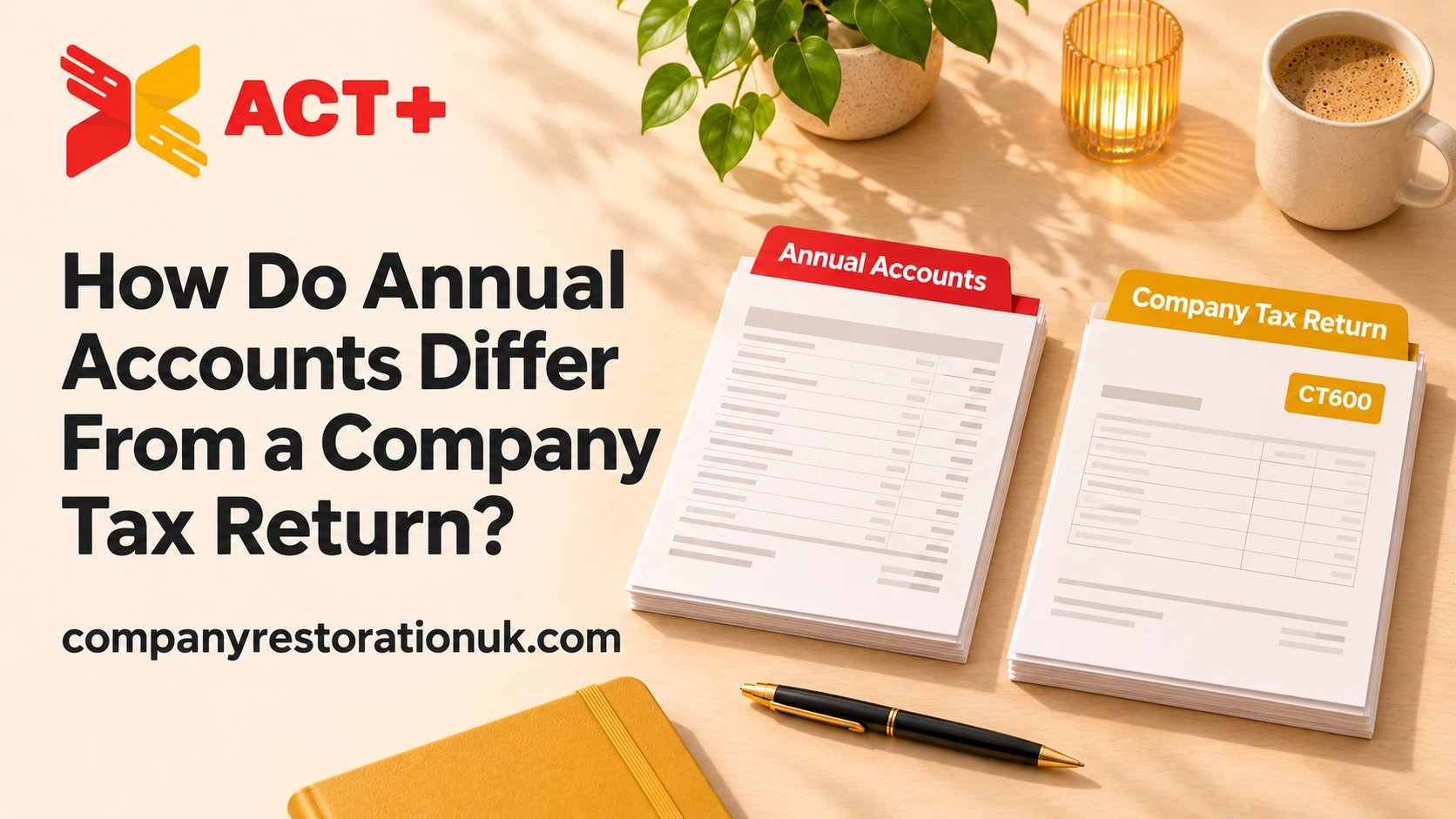
Annual accounts report finances, while company tax returns calculate corporation tax.Companies House receives the applicable statutory accounts filing. HMRC receives the company tax return and required supporting documents.
Accounting profit and taxable profit can differ. Tax computations adjust accounting figures under corporation tax rules. Depreciation, capital allowances, and disallowable expenses can create differences. Preparing accounts alone does not complete the tax return.
Use suitable commercial software for normal electronic company tax return filing.
HMRC closed its former joint filing service on 31 March 2026. From April 2026, businesses generally need commercial software for HMRC submissions.Limited exceptions permit paper returns. Companies House currently provides separate filing routes.
Reconcile records, prepare statements, obtain approval, and complete the required submissions.Start preparation early enough to investigate missing information. Allow time for director questions and filing corrections.
Check acceptance after submission. A transmission receipt alone might not confirm successful filing. Monitor rejection messages and correct problems promptly. Keep the final accepted version alongside submission evidence.
Yes. Current guidance sets software-only accounts filing from 1 April 2028.Review software compatibility before that date. The requirement covers Companies House account submissions. The government has paused the planned small-company profit-and-loss filing requirement. That pause does not cancel the software-filing timetable.
Companies House charges private companies automatic late-filing penalties.The penalty depends on how late acceptable accounts arrive.
Companies House doubles penalties for late accounts in consecutive financial years. HMRC applies separate penalties for late company tax returns.Persistent filing failures can also trigger enforcement and strike-off action.
Can You Appeal an Accounts Penalty?
Yes. Explain the exceptional circumstances and provide supporting evidence.An appeal does not guarantee cancellation. Dormancy or unfamiliarity with deadlines does not automatically justify an appeal.Keep a clear timeline and relevant correspondence.
Check the company’s current status before deciding the next step. A strike-off proposal differs from completed dissolution. Outstanding compliance work might still help prevent dissolution.
Administrative restoration requires outstanding accounts and other applicable overdue documents. Start with the filing history and dissolution date. Identify missing accounting periods before preparing the restoration application.Companies House also requires outstanding confirmation statements and applicable payments. Court restoration follows a separate procedure and any court directions.
The review should produce a schedule of outstanding accounting periods.Record each period’s deadline, trading status, and required account format. Confirm the submission sequence for the applicable restoration route.
Obtain bank statements covering the relevant periods. Review the director's loans, borrowings, and assets remaining at dissolution.Do not assume every missing period qualifies for dormant accounts. Do not estimate penalties by counting missing years alone. Restoration rules treat certain dissolution-period filing deadlines differently. Check the restoration route and statutory penalty provisions.
How Do Missing Records Affect Restoration Preparation?
Missing records can delay administrative restoration. Companies House requires outstanding annual accounts with your RT01 application. If key records are missing, your accountant may need to reconstruct the figures before those accounts can be filed.
Start with the earliest outstanding financial year. Request missing bank statements and payment platform reports. Ask customers or suppliers for copies of invoices. If you’ve changed accountants, request the previous year’s accounts and closing balances. These help establish what the company owned and owed at the start of the next year.
If you cannot replace lost records, do your best to recreate them. Tell your corporation tax office straight away. Include details of the missing records in your company tax return.
Normally, keep records for six years after the relevant financial year-end. Some circumstances require longer retention. These include certain long-running transactions and HMRC compliance checks. Retain statements, invoices, calculations, and supporting agreements. Store final accounts separately from drafts. For restoration cases, preserve historical records throughout the recovery process.
Frequently Asked Questions
Yes. Directors can prepare accounts themselves if they meet the requirements. They must apply the correct accounting rules and disclosures. Professional support can help with complex balances or missing historical records.
Yes. A trading loss does not remove annual account obligations. The accounts must still report the company’s financial position. Review the corporation tax reporting separately.
No. A confirmation statement updates specified company information.Annual accounts report the company’s finances. Companies must meet each applicable filing obligation separately.
Eligible companies can currently omit it from their Companies House filing.That exemption does not remove appropriate statutory accounts preparation requirements. Check shareholder and HMRC requirements separately.
Yes. Submit amended accounts covering the same original accounting period. Use an available correction route and provide the required statements. Companies House retains the original accounts on its public record.
No. Restoration does not automatically cancel existing account penalties.Check each penalty against its original deadline and restoration rules. Distinguish pre-dissolution arrears from deadlines falling during dissolution.
Get Help With Annual Accounts and Company Restoration
Request a review of your company’s accounts and filing position.Share the company number, latest accounts, and outstanding filing notices. For dissolved companies, include the dissolution date and available financial records.Our team can identify missing periods and explain preparation requirements. Request a written quote covering professional fees and additional charges.
Speak to a restoration specialist today — most eligible companies are back on the register in 4–6 weeks.
Start restorationSend the basics. A case manager checks the register and comes back with the route, the documents and the official costs.
Start with how the company was dissolved.
These answers help estimate work and official costs.
We use these details only to review your case and reply to you.
When you press Send My Details for a Free Review, your answers and contact details are sent to the Xact+ restoration team for a free case review. Read the privacy policy.
This is an indication from your answers, not a formal assessment.

Leave a comment